If you've gotten an HVAC quote in the last 18 months, there's a decent chance your contractor mentioned R-410A being "phased out" and you half-listened, assumed it was a 2035 problem, and moved on. We want to fix that. The R-410A phase-down is not a future policy — it is a present economic event that is already changing repair pricing, equipment availability, and the replace-vs-repair decision for every homeowner with a pre-2025 central AC. Here's what's actually happening, why, and what it means for your specific situation.
01The policy in plain English
In 2020, Congress passed the AIM Act (American Innovation and Manufacturing Act), which directed the EPA to phase down production and import of hydrofluorocarbons (HFCs) — the class of refrigerants that includes R-410A — by 85% over 15 years. The phase-down is structured in calibrated steps: production allowances are allocated to manufacturers each year, and those allowances shrink according to a Congressionally-mandated schedule. This is not a ban; it's a supply squeeze.
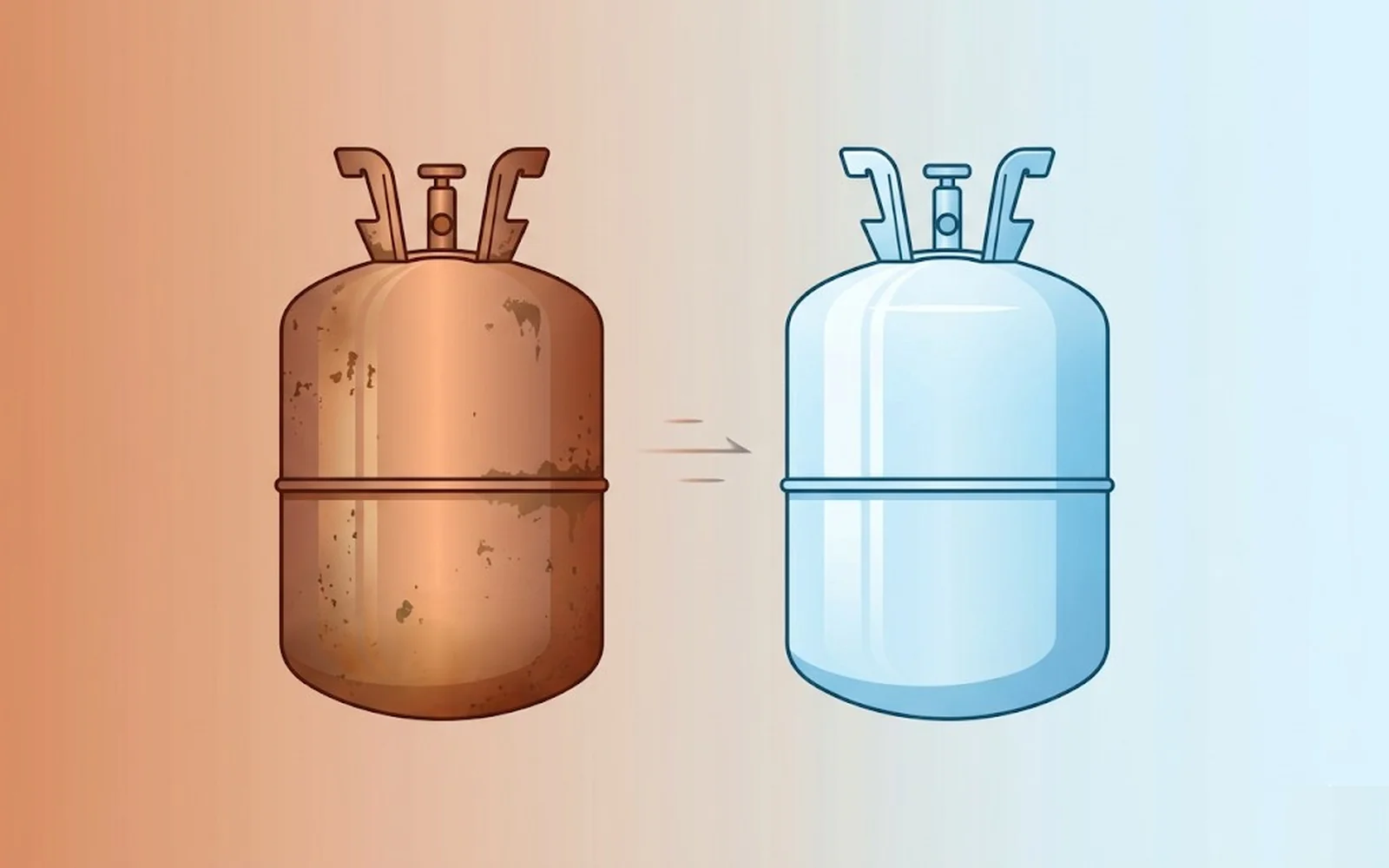
The practical effect on the residential HVAC industry is this: as of January 1, 2025, new residential air conditioners and heat pumps can no longer be manufactured with R-410A as the factory refrigerant. Units shipping from that date forward use R-454B, with a handful of manufacturers offering R-32 systems. Both R-454B and R-32 are lower-GWP (global warming potential) refrigerants — R-454B is roughly 78% lower GWP than R-410A.
What "A2L" means and why it matters
R-454B and R-32 are classified as A2L refrigerants — ASHRAE's class for "mildly flammable" refrigerants. This is not propane-torch flammable. It requires a specific concentration in air and an ignition source within a narrow window to combust. But it is non-zero flammable, which means manufacturers had to redesign equipment with leak detection, ignition-source controls, and updated service protocols. Techs servicing A2L systems need to be EPA 608 certified plus have manufacturer-specific A2L training, and they need refrigerant recovery machines rated for A2L operation.
This is why the transition isn't "just swap the refrigerant" — it's a top-to-bottom equipment and training overhaul.
02The phase-down timeline that actually affects you
The AIM Act step-downs that matter for residential:
Service-grade R-410A remains legal indefinitely after 2036 for existing systems, but supply will be limited to reclaimed refrigerant — R-410A recovered from decommissioned systems, cleaned, and recertified. Virgin R-410A production is what's being eliminated. This is the same pathway R-22 (the pre-2010 refrigerant) went down — and R-22 today costs roughly $150–$250 per pound when you can find it, compared to $15–$25 per pound a decade ago.
R-22 is the warning shot. R-410A is the next in the same sequence, on the same curve, driven by the same policy logic.
03What this means for repair pricing — already, not someday
Our contractor network has tracked R-410A spot pricing monthly since 2022. Here's the trend we're seeing at the wholesale distributor level:
That's roughly a 3x increase in four years. For a typical residential refrigerant recharge — 2 to 4 pounds — the raw refrigerant cost has moved from about $30 to about $90–$160. Add tech labor, leak check, and vacuum time, and a recharge that used to run $220–$380 now commonly lands at $320–$650. Contractor margins haven't expanded; the underlying material cost has.
The leak decision gets ugly fast
Here's the part that catches homeowners off guard. An R-410A leak is not a one-time expense. Refrigerant doesn't get "used up" — if a system loses charge, there's a leak, and leaks rarely heal themselves. The honest pathway is: find the leak, fix the leak, pressure-test, vacuum, recharge. On an older system with an aging evaporator coil, leak repair often costs $800–$1,800 before refrigerant. If you skip leak repair and just top off, you'll be back in 12–18 months with the same problem and another $400–$600 of refrigerant at 2027 prices.
04When should you actually replace?
We don't subscribe to the "panic replace" narrative some contractors are pushing. Here's our honest framework for R-410A homeowners in 2026:
Replace now if:
- The system is 12+ years old and has any documented refrigerant leak history.
- A compressor replacement is on the table — at 2026 labor rates, a compressor swap on an old R-410A system is 60–75% of a full replacement cost.
- The evaporator coil is leaking (these are notoriously expensive to replace and often indicate broader end-of-life).
- You're in a climate zone where the system runs 6+ months a year and efficiency degradation is compounding your utility bills.
Keep repairing if:
- System is under 8 years old, no leak history, and you're looking at a non-refrigerant repair (capacitor, contactor, blower motor).
- The proposed repair is under $500 and the system's performance data (suction pressure, subcooling, superheat) is within spec.
- You're planning a major home envelope upgrade in the next 24 months that will change the system sizing requirements.
05What to ask a contractor about refrigerant in 2026
When you're getting quotes, these questions separate capable pros from the ones winging it:
06What about the "drop-in replacement" refrigerants?
You'll see marketing from certain aftermarket brands pushing refrigerants like R-407C, R-422D, or proprietary "R-410A replacements" as drop-ins. Be careful. None of these are true drop-ins for R-410A. Pressures differ, oils may be incompatible, and critically, most invalidate your system warranty the moment they're introduced. Some are also unapproved by the equipment manufacturer, which means any subsequent warranty claim will be denied. If a contractor offers to "convert" your R-410A system to a different refrigerant, get that plan in writing with manufacturer approval documentation before agreeing — and expect us to raise an eyebrow.
07The bottom line
R-410A isn't disappearing tomorrow, and there's no regulatory reason to tear out a healthy 6-year-old system. But the cost floor under R-410A service is rising, and every year you delay a replacement decision on an old system is another year of compounding risk. If your unit is 10+ years old and on R-410A, the right move in 2026 is to plan, not panic — get a Manual-J, compare R-454B equipment options, stack the 25C tax credit and utility rebates, and execute in shoulder season at a price you negotiated from a position of information rather than desperation. That's the difference between spending money and wasting it.