
Here's a statistic that should bother every homeowner with central HVAC: according to multiple industry studies from the DOE Building America program and ACCA, somewhere between 40% and 70% of residential central air conditioners in the U.S. are oversized relative to the home's actual thermal load. Not slightly — meaningfully. A home that genuinely needs 2.5 tons of cooling is frequently paired with a 3.5 or 4-ton system. The reason? Rule-of-thumb sizing (typically 500 square feet per ton) is fast, comfortable for the contractor, and catastrophically imprecise. A real Manual-J load calculation is the fix, and it's the single most important document you should demand before signing any HVAC replacement contract. This post explains what it is, why skipping it is expensive, and how to verify yours was actually done.
01What Manual-J actually is
Manual-J is the residential load calculation standard published by the Air Conditioning Contractors of America (ACCA), now in its 8th edition (Manual J8AE). It is the accepted, code-referenced method across the United States for determining the peak heating and cooling loads of a residential structure. The International Residential Code (Section M1401.3) and International Energy Conservation Code both require Manual-J-compliant load calculations for new construction and most replacements. In practice, enforcement varies wildly by jurisdiction, which is why so many installs skip it.
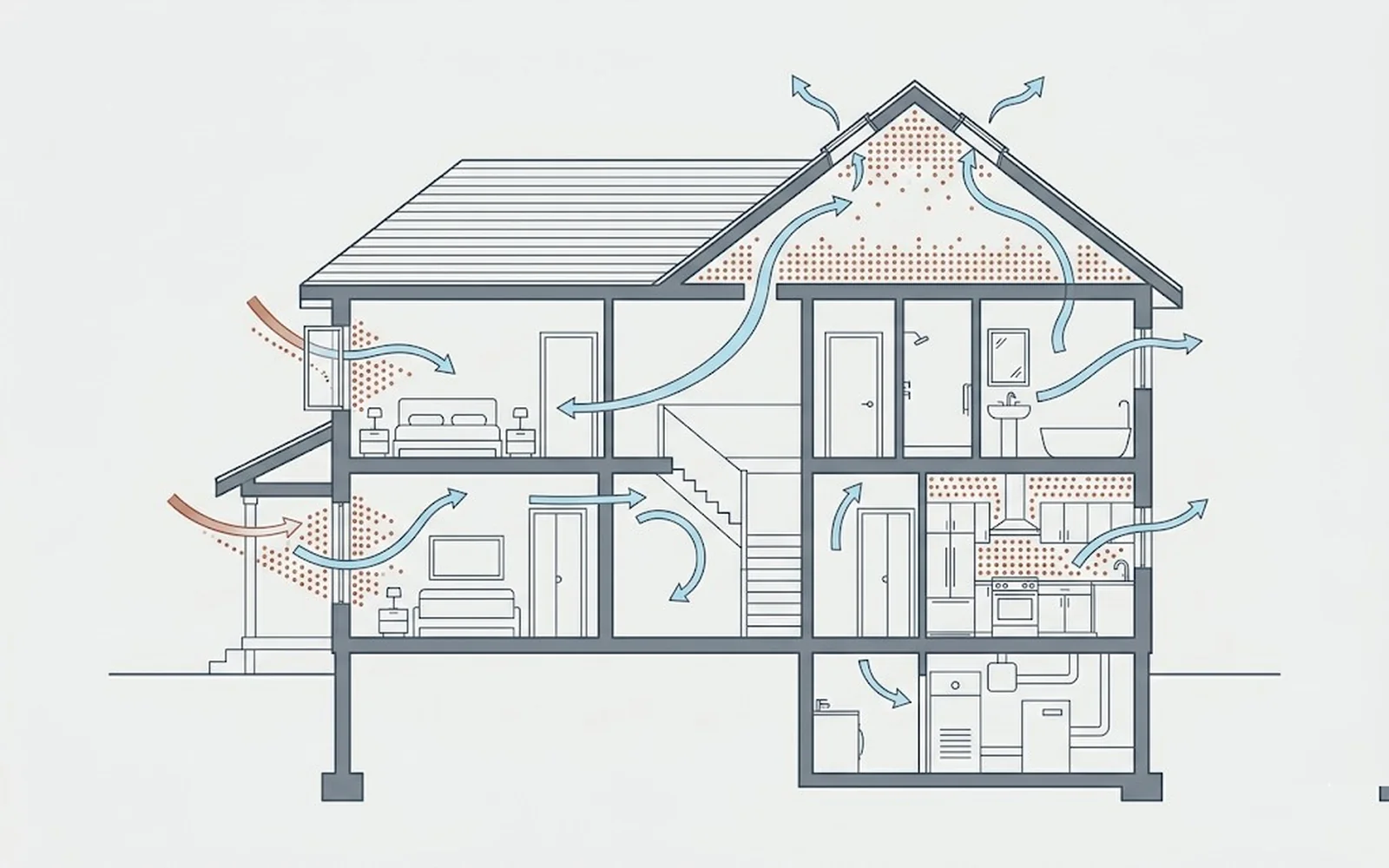
A Manual-J calculation is not a spreadsheet with square footage in one cell. It's a room-by-room analysis that accounts for:
When done correctly with software like Wrightsoft Right-J, Elite Software Rhvac, or CoolCalc, the output is a room-by-room sensible and latent load breakdown that feeds directly into Manual-S (equipment selection) and Manual-D (duct design). You need all three for a defensible system design.
02Why oversizing is worse than you think
Every HVAC contractor has sold the same bad logic at some point: "bigger is better, cools faster, no complaints." It is completely wrong, and here's why.
Short cycling
An oversized AC reaches the thermostat setpoint too quickly, shuts off, and then comes back on a few minutes later when the thermostat drifts. This pattern — called short cycling — is brutal on equipment. Compressors draw 4–8x their running amperage at startup, and every start accelerates wear. A system cycling 8 times an hour wears roughly as fast as a correctly-sized system cycling 3 times an hour running longer cycles.
Humidity control collapses
Air conditioners remove humidity by condensing moisture on a cold evaporator coil. That process requires runtime — the coil needs to stay below the dewpoint long enough for significant condensation to drain. An oversized system satisfies the thermostat before meaningful dehumidification happens, which is why oversized ACs in humid climates produce "cold and clammy" conditions. Homeowners set the thermostat lower to compensate, which makes the energy problem worse without fixing the humidity problem.
The most common complaint we hear about brand-new systems isn't that they don't cool — it's that the house feels clammy. Almost every time, it's an oversizing problem.
Efficiency degradation
Modern variable-speed equipment (Trane XV20i, Carrier Infinity 24VNA6, Lennox SL28XCV, Daikin DX20VC) mitigates some short-cycling issues by modulating output. But single-stage and two-stage equipment — still the majority of installed base — is sharply penalized by oversizing. Independent lab data from DOE Building Technologies research shows single-stage oversized systems running 20–35% worse than their AHRI-rated SEER2 in real operation.
Comfort distribution
Oversized equipment pushes too much air through ducts designed for a smaller load. Velocity rises, static pressure climbs, noise increases, and rooms farther from the air handler get poorly conditioned because short cycles never let the system reach steady-state airflow distribution.
03The signs you got wrong-sized equipment
If any of these are familiar, you're probably living with a sizing problem:
- The system satisfies the thermostat in 6–9 minutes of runtime, then shuts off, then restarts 8–15 minutes later.
- House feels cold but sticky in summer. Indoor relative humidity reads above 55%.
- Some rooms are 4–8°F different from the thermostat-controlled room.
- Outdoor unit is noisy on startup — the big inrush surge.
- Bills are higher than comparable neighbors despite a "newer" system.
- Equipment has needed compressor, contactor, or capacitor service more than once in its first 8 years.
None of these individually prove oversizing, but the pattern is distinctive and we see it constantly during diagnostic visits on systems under 10 years old.
04How to verify your contractor ran a real Manual-J
This is where it gets concrete. When you ask a contractor for a "Manual-J," here's what you should actually receive:
If what you got is a one-page sheet with "House square footage: 2,400. Recommended tonnage: 4.0," that is not a Manual-J. It is a rule-of-thumb estimate dressed up to look like one. Push back.
The walk-through test
A Manual-J cannot be done from the driveway. A contractor running a legitimate load calc will:
- Measure room dimensions with a laser measure or tape.
- Count and measure windows, noting orientation on each wall.
- Ask about (or inspect) attic insulation depth and wall insulation type.
- Ask when the home was built and what energy code was in effect.
- Look at the existing ductwork and ask about comfort complaints by room.
- Spend 30–60 minutes in the home, not 10.
If your contractor walked through in under 15 minutes and quoted you a system size from the truck, that system was not load-calculated.
05What a proper Manual-J costs
Many reputable contractors include Manual-J with their replacement quote. Some itemize it at $150–$450 depending on home complexity. Independent third-party load calcs (useful for disputes or for new construction before contractor selection) run $300–$700. That is cheap insurance on a $7,000–$12,000 equipment decision. We'd rather see a homeowner spend $400 on an independent Manual-J and catch an oversizing error than spend $2,500 more over a decade on oversized-equipment utility bills.
06When rule-of-thumb kind of works
We'll be honest — the 500 sq ft per ton heuristic isn't random. It approximates a certain kind of home: decently insulated, average windows, average orientation, average climate. For a mid-1990s Texas ranch built to 1995 code, rule of thumb will land within about 15% of reality, and most contractors will quote a tonnage that's close enough to not cause active harm.
The heuristic fails — often dramatically — on:
- Homes built to modern IECC 2018+ code (much tighter envelopes, lower loads).
- Older homes that have been retrofit-insulated or re-windowed.
- Homes with unusual orientation, large glass walls, or vaulted spaces.
- Homes in extreme climate zones (hot-humid Gulf or cold-heavy northern).
- Additions or partial retrofits.
In other words: the cases where getting it right matters most are exactly the cases where rule-of-thumb fails hardest. That's why the standard exists.
07The bottom line
If you're replacing a system in 2026, Manual-J is not optional. It's the difference between buying a system that will cost $X per year to run for 15 years, and one that costs 25% more while also being less comfortable. Demand it in writing. Verify what you got. If the contractor won't or can't produce it, that's a signal about everything else they'll skip on the install. There are plenty of excellent contractors who do this work by default — our vetted network runs Manual-J on every replacement quote, and if a homeowner wants to see the report, they send it. That's the standard you should hold every bidder to.