
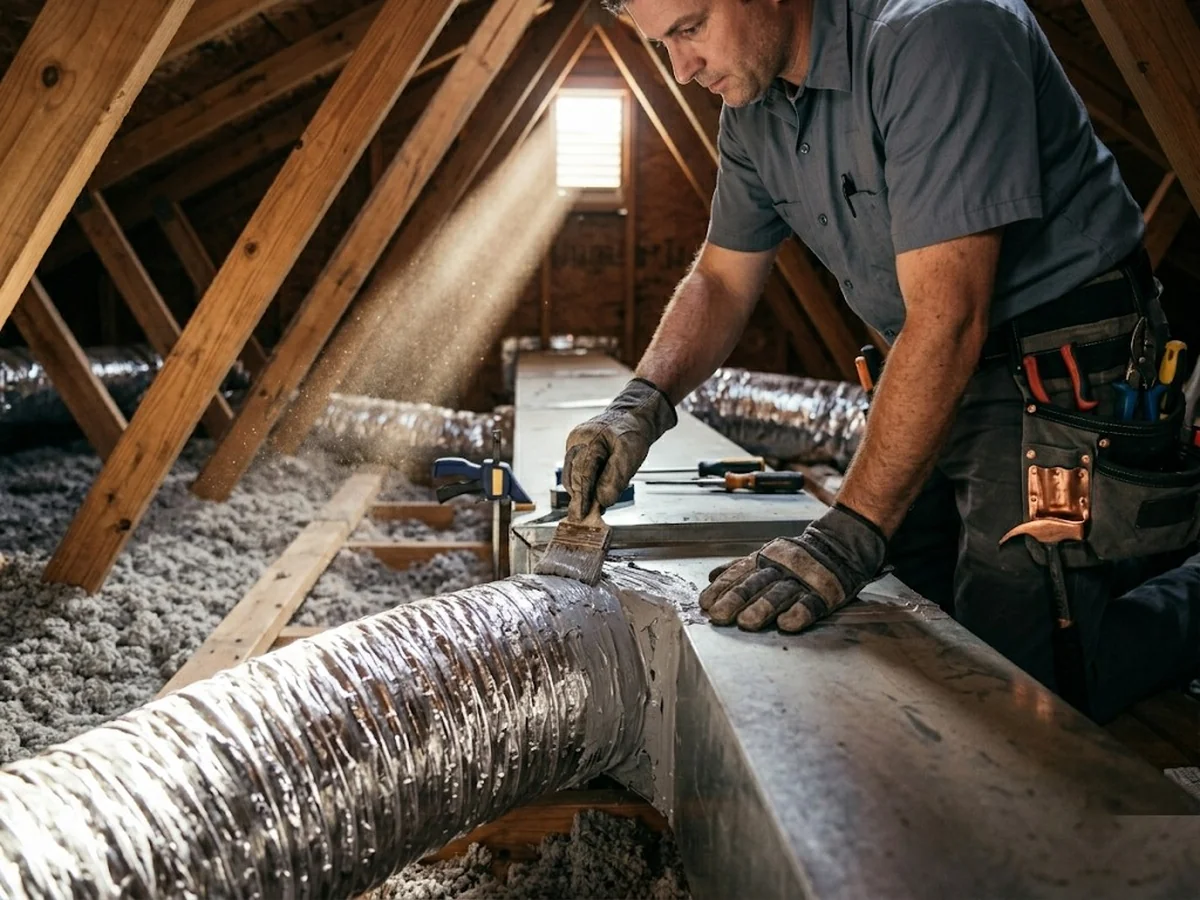
Ductwork, Duct Cleaning, and Air Balancing: What Works, What Is a Scam
Ductwork is where most HVAC systems quietly fail. A perfectly sized, correctly installed air conditioner connected to leaky or undersized ducts still cannot cool hot rooms, still runs up your energy bill, and still wears out early. Our network includes contractors who test ducts (not just clean them), seal them using Aeroseal or hand-seal with mastic, and balance airflow using Manual D principles. We will also tell you honestly when duct cleaning is unnecessary, because often it is.
- Duct cleaning in 2026 costs $450 to $1,200 but is not always needed; the EPA recommends it only under specific conditions.
- Duct sealing with Aeroseal averages $1,800 to $3,800 and pays back in 3-6 years through energy savings.
- Air balancing to ACCA Manual D principles runs $350 to $1,200 and fixes hot and cold rooms most HVAC fixes cannot.
- Leaky ducts waste 25-40% of HVAC output on average; duct sealing is one of the highest-ROI home efficiency projects available.
- Indoor air quality improvements come more from source control than from duct cleaning alone.
01The Part of Your HVAC System Most Contractors Ignore
Ask ten HVAC companies to quote a new system, and nine of them will spend their time on the condenser, the coil, and the furnace. Only one will actually measure the ductwork. This is a shame, because ductwork is where most HVAC systems fail silently. The equipment may be rated at 18 SEER2, but if the duct system loses 30% of its airflow to leaks in an unconditioned attic, you are getting 12.6 SEER2 of actual performance. Research from the Department of Energy and Lawrence Berkeley National Lab has documented this pattern for decades: duct losses in typical U.S. homes wipe out a meaningful share of the efficiency homeowners paid for.
Ductwork problems fall into three categories: leakage (air escaping to places it should not), imbalance (some rooms get too much air, others too little), and contamination (dust, mold, vermin, or moisture in the duct interior). Each has a different diagnosis and a different fix, and matching the right intervention to the actual problem is where homeowners most often get misled. The radio-ad $89 duct cleaning is rarely the answer to any of these problems; legitimate duct work requires measurement, not marketing.
02When to Call a Pro (And When to Skip It)
03What Duct Work Actually Costs in 2026
Pricing here varies enormously by home size, duct accessibility, and the specific service performed. Here is what you can expect:
For context on the energy cost of duct leakage, the U.S. Department of Energy's Minimizing Energy Losses in Ducts page estimates typical American homes lose 20-30% of heating and cooling energy to duct leakage. On a $2,400 annual HVAC bill, that is $480-$720 per year going directly to the outdoors.
04Step-by-Step: What a Duct System Diagnosis Looks Like
05Red Flags: How to Spot a Bad Duct Contractor
06How Our Matching Works for Ductwork and Airflow
Duct work matching is specialty matching. We verify that contractors in this pool carry the right equipment (duct blaster, flow hood, manometer, borescope, truck-mounted negative air for cleaning jobs, Aeroseal certification if offering that service), follow Manual D design principles on replacement or expansion work, and have low customer complaint rates on our post-service surveys. Not every HVAC contractor in our general network is qualified for duct work; we maintain a separate, smaller pool for this specialty.
For diagnostic calls, we typically match a single contractor who can measure the system and scope the problem. For larger projects (Aeroseal sealing, full duct replacement, air balancing on complex homes), we match 2-3 contractors so you can compare quotes and approaches. Aeroseal in particular is dealer-network-only, so we match from that verified dealer list specifically. The EPA's guidance on duct cleaning is one of the primary references our contractor-training materials reference, along with ACCA Manual D for design work.
07Questions to Ask Before You Hire a Duct Contractor
- Will you perform a duct leakage test (duct blaster) and provide the CFM25 results in writing?
- Will you measure static pressure at the supply and return, and provide those numbers?
- Will you measure register airflow with a flow hood or anemometer?
- If recommending cleaning, what specific contamination have you identified, and can I see it via borescope footage?
- For sealing jobs, do you offer Aeroseal, hand mastic seal, or both, and what are the pros and cons for my house?
- For replacement, can you provide a Manual D design for the new system, not just a "like-for-like" bid?
- What is your equipment: truck-mounted negative air with HEPA, or portable vacuum?
- Do you provide a written before-and-after comparison for measurable work (leakage CFM, static pressure, register airflow)?
08Authoritative Resources
- EPA: Should You Have the Air Ducts in Your Home Cleaned? — the definitive guidance on when cleaning is and is not appropriate
- U.S. DOE: Minimizing Energy Losses in Ducts — duct leakage impact on energy costs
- ACCA Manual D: Residential Duct Systems — the engineering standard for sizing and design
Good ductwork is invisible: every room is comfortable, bills are reasonable, the system runs quietly, and no one ever thinks about the tubes in the attic. Bad ductwork is the reason most HVAC systems disappoint. When you want a real diagnosis, a real quote, and a real measurement-driven fix, our network has the specialists who will deliver it.
What ductwork & airflow actually costs.
12-month aggregate from our contractor network, national average. Your actual quote depends on equipment, access, and scope.
| Service item | Typical range | What's included |
|---|---|---|
| Duct inspection + video camera scope | $125 - $295 | Identifies issues before work quoted |
| Basic duct cleaning (single-system) | $450 - $900 | Truck-mounted HEPA negative air |
| Comprehensive duct cleaning (large home) | $700 - $1,500 | Multi-system or 3,500+ sq ft |
| Aeroseal duct sealing | $1,800 - $3,800 | Proven 90%+ leak reduction |
| Hand-seal with mastic (targeted) | $495 - $1,650 | Accessible joints only |
| Air balancing (whole home) | $350 - $1,200 | Static pressure + register measurements |
| Return duct addition (new branch) | $550 - $1,450 | Fixes return-starved systems |
| Ductwork replacement (full home) | $6,500 - $15,000 | Flex to sheet metal upgrade common |
| Ductwork replacement (flex to flex) | $3,500 - $8,500 | Lower-cost option for crawlspace systems |
| Dryer vent cleaning | $145 - $295 | Often bundled with duct cleaning |
| UV-C germicidal light installation | $395 - $895 | Coil-sterilizing; limited IAQ benefit alone |
| Whole-home HEPA air purifier (in-duct) | $895 - $2,800 | Media purifier; genuine IAQ improvement |
Ductwork & Airflow pricing varies by state.
Top 10 U.S. states by population — pricing variance vs. national average for ductwork & airflow.
| State | Pricing vs. national | Why |
|---|---|---|
| California | +14% | Pacific HVAC pricing runs 15-20% above national average due to high labor costs, Title 24 (CA) energy compliance overhead, and seismic strap |
| Texas | Baseline | South Central pricing runs at or slightly above national average for cooling work due to high tonnage requirements; heating is below average |
| Florida | -5% | Southeast HVAC pricing runs 5-10% below national average for cooling work due to high contractor density and equipment sales volume; heating |
| New York | +10% | Northeast HVAC pricing typically runs 10-15% above national average due to higher labor costs, dense urban access challenges, and oil-to-gas |
| Pennsylvania | +10% | Northeast HVAC pricing typically runs 10-15% above national average due to higher labor costs, dense urban access challenges, and oil-to-gas |
| Illinois | Baseline | Midwest pricing tracks close to national average; heating-related work runs slightly higher due to extended winter season and higher heat-pu |
| Ohio | Baseline | Midwest pricing tracks close to national average; heating-related work runs slightly higher due to extended winter season and higher heat-pu |
| Georgia | -5% | Southeast HVAC pricing runs 5-10% below national average for cooling work due to high contractor density and equipment sales volume; heating |
| North Carolina | -5% | Southeast HVAC pricing runs 5-10% below national average for cooling work due to high contractor density and equipment sales volume; heating |
| Michigan | Baseline | Midwest pricing tracks close to national average; heating-related work runs slightly higher due to extended winter season and higher heat-pu |
Ductwork & Airflow issues our network sees most.
One or two rooms always hotter or colder than the rest of the house
Diagnosis: Airflow imbalance from undersized supply ducts, damaged flex, collapsed lines, or lack of return air.
Typical fix: Static pressure test, airflow measurement at each register, damper adjustment, possibly new return branch. — $350 - $1,850
High utility bills despite new/efficient HVAC system
Diagnosis: Duct leakage in unconditioned spaces (attic, crawlspace, garage) wastes 20-40% of conditioned air.
Typical fix: Duct blaster leak test, identify leaks, seal with Aeroseal or mastic, retest to verify improvement. — $1,800 - $4,500
Excessive dust throughout home
Diagnosis: Leaky return ducts pulling unconditioned air and particulates, undersized filter, or compromised duct insulation.
Typical fix: Locate and seal return-side leaks, upgrade filter housing, inspect for fiberglass shedding or mold. — $450 - $2,200
Musty smell when HVAC runs
Diagnosis: Biological growth in ducts or on evaporator coil, typically from prolonged high humidity or condensate issues.
Typical fix: Source control (humidity, coil cleaning), duct cleaning if contamination verified, UV-C installation as secondary measure. — $395 - $1,850
Whistling or roaring noise from registers
Diagnosis: High static pressure from undersized ducts, too few returns, or partially closed dampers.
Typical fix: Static pressure measurement, register inspection, duct sizing analysis, corrective work per Manual D. — $295 - $1,250
Condensation or water dripping from supply registers
Diagnosis: Uninsulated or poorly insulated supply ducts in humid unconditioned spaces; air temperature below dew point.
Typical fix: Insulate ducts to R-8 minimum, seal vapor barrier, address space humidity if extreme. — $495 - $2,200
Ductwork & Airflow: step-by-step.
From the moment you call 1-877-877-6723 to the moment work is complete.
On-site assessment
Tech inspects accessible ductwork (attic, crawl, basement). Measures airflow at registers, static pressure at multiple points. Identifies issues + scope.
Diagnostic testing
Manometer pressure-test for duct leakage (CFM/100sqft). Smoke test for leak location if needed. Manual D calc for resizing recommendations.
Quote + plan
Written scope: which sections need sealing, replacement, balancing. Cost breakdown by scope item. Quote for performance test post-completion.
Execution work
Mastic sealing of accessible joints. Aeroseal for sealing inaccessible runs (whole-home spray-in). Replacement of crushed/damaged sections. Damper adjustments. Insulation as needed.
Performance verification
Re-test duct leakage post-work (target <0.05 CFM/100sqft). Re-measure airflow at all registers. Verify static pressure normalized.
Ductwork & Airflow: what's safe to DIY vs hire out.
Some tasks are simple homeowner jobs. Others legally require a licensed contractor.
| Task | Verdict | Why |
|---|---|---|
| Replace air filter monthly | DIY OK | 5 min, no tools. Restrictive filter increases static pressure + reduces airflow throughout duct system. |
| Adjust register dampers (open/close to balance) | DIY OK | Use lever or wheel on each register. Closing some balances airflow to others. Don't close more than 25% of registers (causes pressure backup). |
| Vacuum register grilles + visible ductwork interior | DIY OK | Vacuum brush attachment removes accumulated dust. Wipe register grilles with damp cloth. |
| Mastic sealing of duct joints | DIY OK | Brush-on duct mastic is DIY-friendly for accessible joints. Wear gloves. Cure 24 hrs before running system. |
| Pressure-test ducts for leakage | Hire pro | Requires manometer + duct blaster ($1,500+ equipment). Pro only. |
| Replace ductwork sections | Hire pro | Requires sheet metal tools + understanding of static pressure / Manual D sizing. Wrong sizing = whole system airflow problems. |
| Install zoning system + dampers | Hire pro | Requires control wiring + careful Manual D calculation. Mistakes cause pressure backup + equipment short cycling. |
| Aeroseal aerosol sealing | Hire pro | Requires specialized equipment + training. $20K+ contractor investment. |
What your ductwork & airflow technician will bring.
Standard equipment a licensed ductwork & airflow contractor carries:
- Manometer (digital, dual-port for static pressure)
- Duct blaster fan + frame for leakage testing
- Smoke pencil for visual leak detection
- Anemometer for airflow measurement at registers
- Mastic sealant + brushes
- Foil tape + insulation
- Sheet metal tools + flex duct + rigid duct inventory
- Aeroseal aerosol equipment (specialized)
Every major brand for ductwork & airflow.
| Manufacturer | What our network technicians note |
|---|---|
| Aeroseal | Patented aerosolized sealing technology; reduces duct leakage by 90%+ in one treatment; industry gold standard; certified dealer network only. |
| Rotobrush / Hypervac | Leading duct-cleaning equipment brands used by reputable services; truck-mounted negative air with HEPA filtration is the standard. |
| Hart & Cooley | Premium sheet metal register and diffuser manufacturer; architectural-grade options for higher-end homes. |
| Imperial Duct | Galvanized steel duct systems; proper sheet metal still outperforms flex for main trunk applications. |
| Flexmaster / Thermaflex | Premium flex duct manufacturers; R-8 insulated flex is the standard for residential branches since 2022 code changes. |
| Broan-NuTone / Panasonic | Leading bathroom exhaust and whole-house ventilation manufacturers; mandated by code in many jurisdictions for air quality. |
| Aprilaire | Premium whole-home media air cleaner and dehumidification specialist; OEM partner for many HVAC brands. |
| Honeywell Home / Resideo | Smart zoning controls and damper systems; retrofitting zones into existing ductwork is often better than full replacement. |
Ductwork & Airflow red flags to watch for.
Common scam patterns in ductwork & airflow that should make you walk away.
Pushes 'whole home duct cleaning' without showing dirty ducts
Duct cleaning industry has heavy upsell culture. NADCA standards require cleaning only when visible debris, mold, or vermin present. Most homes don't need it more than every 3-5 years.
Quotes duct sealing without pressure-testing first
Pressure test is required to identify leakage CFM and location. Without it, sealing is guesswork.
Won't show before/after pressure-test results
Before/after comparison proves the work reduced leakage. Without it, you have no way to verify the work was done.
Quotes 'mold treatment' without IAQ test confirming mold
Mold remediation requires positive identification (visual or air sampling). 'Treatment' without testing is sales tactic.
Ignores Manual D calculation for additions/changes
Adding/modifying ductwork without resizing calculation creates pressure problems throughout the system.
Recommends UV lights as 'IAQ solution' without ventilation analysis
UV lights only kill microbes that pass within inches. Real IAQ improvement requires filtration (MERV 11-13) + ventilation (ERV/HRV) + source control (sealing leaks).
HVAC cost calculator — estimate in 30 seconds.
Tell us a bit about your home and we'll estimate your install range based on 12 months of network quote data. Not a binding quote — matched contractors confirm after an in-home assessment.
Estimate range based on 12-month aggregate network quote data. Matched contractor confirms after in-home Manual-J load calc.
8 questions about ductwork & airflow.
Does duct cleaning actually help?+
Sometimes. The EPA's guidance is specific: duct cleaning is recommended when there is visible mold growth, evidence of vermin infestation, or ducts clogged with dust and debris to the point of blocking airflow. For routine dust in a well-maintained system with good filtration, duct cleaning is not clearly beneficial.
How much does duct cleaning cost?+
A legitimate duct cleaning in 2026 runs $450 to $1,200 for a single-system home, $700 to $1,500 for larger or multi-system homes. The $99 groupons are almost always bait-and-switch; actual duct cleaning requires truck-mounted negative air equipment and takes 3-5 hours to do properly.
What is Aeroseal and is it worth it?+
Aeroseal is a patented aerosolized adhesive sprayed into pressurized ducts that finds and seals leaks up to 5/8 inch. It typically reduces duct leakage 85-95% in one treatment. For leaky duct systems, Aeroseal delivers genuine energy savings and comfort improvement, often paying back in 3-6 years on utility bills.
Why does one room never cool properly?+
Ninety percent of the time, the answer is airflow: undersized supply duct to that room, lack of adequate return air path, damaged or kinked flex duct, or an unbalanced damper. No amount of AC tonnage upgrade fixes an airflow problem. Proper diagnosis requires static pressure and register CFM measurement.
Can duct sealing lower my energy bills?+
Yes, significantly. Average U.S. homes leak 20-30% of their conditioned air through duct gaps, and leakage in unconditioned spaces (attics, crawlspaces) is a complete loss. A properly sealed duct system typically cuts 10-20% off heating and cooling costs; whole-home comfort usually improves noticeably.
What is air balancing?+
Air balancing is the process of measuring and adjusting airflow to each register so every room receives its design CFM per Manual D. It addresses the common problem of hot and cold rooms. Proper balancing requires a flow hood or anemometer, static pressure measurement, and adjustable dampers; it takes 2-4 hours on a typical home.
Should I replace my ductwork or just clean it?+
Replacement is warranted when ducts are severely damaged, asbestos-containing, undersized for current equipment, or if the home has significant comfort issues traceable to duct design. Cleaning is appropriate for contamination or heavy dust loading. Most homes benefit more from sealing and balancing than from either cleaning or replacement.
What about indoor air quality products like UV lights and HEPA filters?+
Results vary. Coil-mounted UV-C lights prevent biological growth on evaporator coils and in drain pans (proven benefit) but do not meaningfully clean room air. Whole-home HEPA media purifiers in the ductwork deliver genuine air-quality improvement. Ionization and ozone-based systems remain controversial and under FDA scrutiny.
You might also need…
Need ductwork & airflow now?
Free match · 90 seconds · Licensed pros only · Quote before work