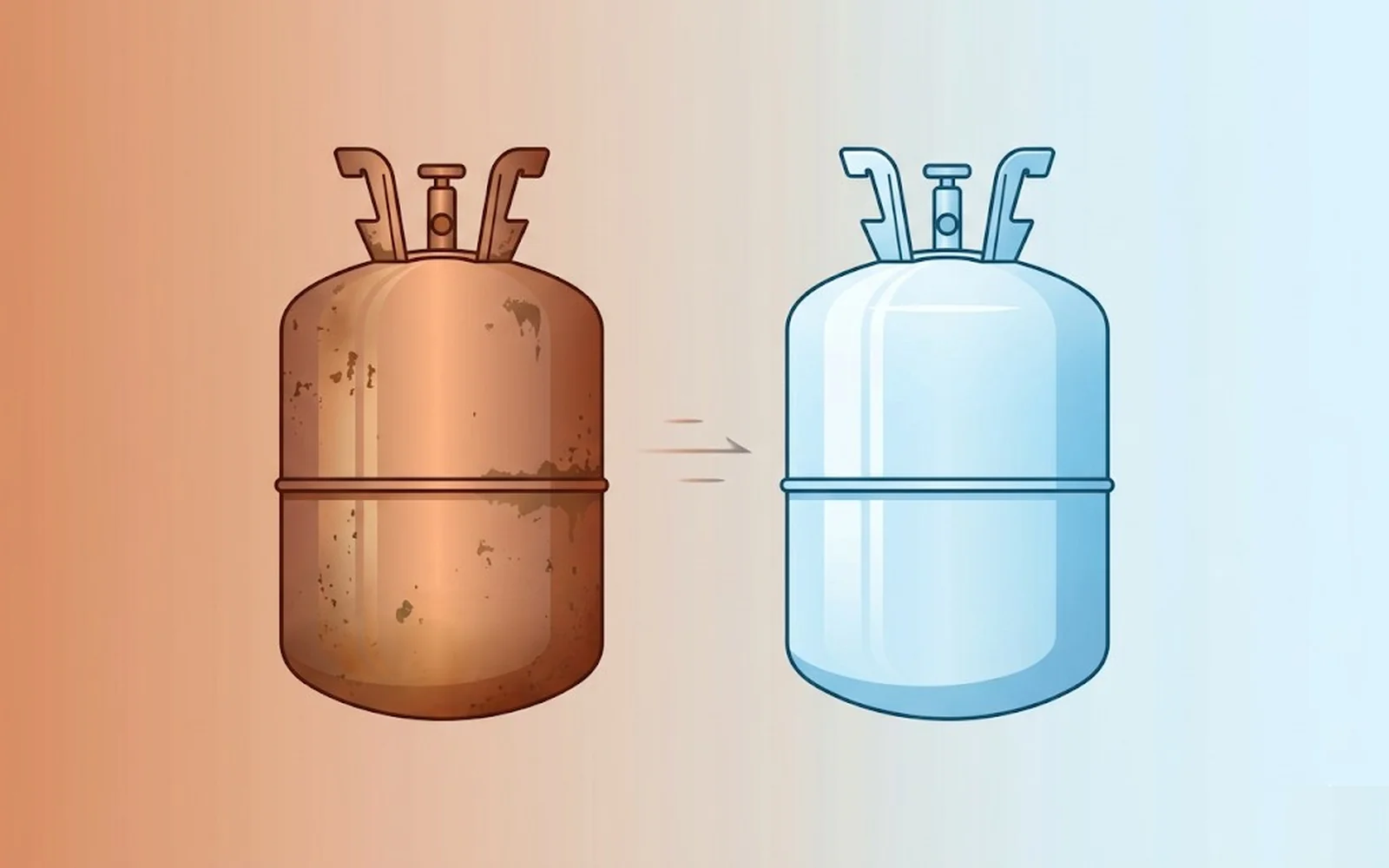

We get this question more than any other between February and April: is it worth sinking another $900 into my 12-year-old AC, or should I just bite the bullet and replace? It's the right question to ask, and the answer in 2026 is different than it was even two years ago. Three forces have converged — the R-410A refrigerant phase-down, the Inflation Reduction Act's 25C tax credit, and peak-season pricing pressure — and together they've pushed the decision math in ways most homeowners haven't caught up to yet. This guide walks through how we actually counsel customers, the numbers behind it, and where the "it depends" lives.
01The repair-versus-replace math homeowners get wrong
The old rule of thumb was simple: if the repair costs more than half the price of a new system, replace. That heuristic is obsolete. We use a sharper version we call the $5,000 rule — multiply the proposed repair cost by the system's age in years. If the product exceeds $5,000, replacement almost always wins on a 10-year total-cost-of-ownership basis. A $600 repair on a 9-year-old unit yields 5,400 — borderline. A $900 repair on the same unit yields 8,100 — clearly lean toward replace.
Why does age matter so much? Because the failure you're looking at today is rarely the last one. A capacitor goes, then a contactor, then a condenser fan motor, and before you've gotten to year twelve you've spent $2,300 on a system that still has a 13 SEER rating and is drinking electricity. The U.S. Department of Energy pegs the useful life of a properly-maintained central AC at 15–20 years, but useful doesn't mean economical. Efficiency degrades, refrigerant leaks develop, and coils accumulate biofilm that cuts heat transfer.
What a "small" repair actually signals
We're not saying every $300 capacitor is a replacement trigger. It isn't. But we are saying that a capacitor failure on a system that's also leaking refrigerant, running warm on the liquid line, and showing high suction pressure is a system telling you something. Single-component failures on an otherwise tight 8-year-old system — fix it. Cascading failures on a 12-year-old unit that's already had a compressor rebuild — stop pouring money into the hole.
02The R-410A phase-out and why 2026 changes the calculus
This is the single biggest shift we've seen in refrigerant policy in a generation, and most homeowners don't know it's happening. Under the EPA's AIM Act HFC phase-down, R-410A — the refrigerant in nearly every residential AC sold between 2010 and 2024 — is being stepped down aggressively. New equipment manufactured after January 1, 2025 ships with R-454B (branded Puron Advance by Carrier, Opteon XL41 by Chemours). R-410A isn't illegal to service, but production is being curtailed, and the pricing has already started to bite.
We've watched R-410A service costs climb 15–30% since early 2025, and the tail on this is long. A refrigerant leak on an R-410A system in 2028 is going to feel very different than it did in 2022.
Here's the practical consequence: if your system is 10+ years old and develops a meaningful refrigerant leak, you're facing a choice between paying escalating R-410A premiums to keep an aging system alive, or replacing with an R-454B-compatible unit that will have a decade of supply runway ahead of it. The refrigerants are not cross-compatible — you can't just top off an R-410A system with R-454B. System architecture, pressures, and oils differ.
This doesn't mean panic-replacing a 5-year-old system that works fine. It means that if you're already on the repair-vs-replace fence and your system uses R-410A, the phase-out tips the decision toward replace.
03The 25C tax credit — real money, finite window
The Energy Efficient Home Improvement Credit (Section 25C) is the quiet workhorse of federal HVAC incentives. As of the current tax year, homeowners can claim:
The credit is non-refundable — you need federal tax liability to use it — and resets annually through 2032 under current law. That said, tax policy is not a permanent feature of the landscape, and we've seen credit structures reshaped mid-stream before. If you're planning a replacement within 12–18 months anyway, the current window is the strongest incentive environment we've seen for residential heat pumps and high-efficiency splits.
Pair 25C with your state's utility rebate (many coops offer $500–$1,500 on qualifying heat pumps through the Energy Star Most Efficient tier) and you can shave $2,500–$3,500 off a qualifying install before you've negotiated anything with the contractor.
Real-money example
Take a Carrier Infinity 24VNA6 variable-speed heat pump, nominally a 3-ton install in a Southern climate. Sticker install in our network runs roughly $9,400. Apply the $2,000 25C credit, a $1,200 utility rebate typical of the region, and a manufacturer spring promo of $600, and you're at $5,600 out of pocket for a system that will draw 30–40% less electricity than the 14-year-old Goodman it's replacing. That's a payback period most homeowners don't calculate correctly because they forget to subtract the incentives.
04Peak-season pricing — why July is the worst month to buy
Every HVAC contractor we've ever worked with tells the same story: quotes written in July are 10–20% higher than the same scope written in March, and not because the equipment costs more. It's because July crews are slammed, overtime is stacking, and homeowners with no cooling at 98°F are in a dramatically weaker negotiating position than homeowners planning ahead in a 62°F spring.
If your system is limping and you can see the end, schedule replacement quotes in late winter or early spring. You'll get more careful Manual-J load calculations, more equipment options to choose from, and a better install experience. We've had customers wait three weeks in August for a confirmed install slot; in March it's four to seven days.
05When waiting actually makes sense
We don't push replacement. There are cases where waiting is the right move:
06How we'd approach the decision in 2026
If we were in your shoes with a tired AC and a repair quote in hand, here's the sequence we'd run:
The frustrating honest truth is that there's no universal answer. A 7-year-old Trane XL20i with a bad capacitor is a $280 repair and a no-brainer. A 13-year-old Goodman SSX with a leaking evaporator coil and a failing condenser fan motor on R-410A is a $1,900 repair band-aid on a system that's going to keep bleeding. The difference between those two outcomes isn't the unit, it's the cumulative wear and the refrigerant environment.
When you're staring at a quote and unsure, run the numbers, don't guess. If you want a second set of eyes, our contractor network will write a no-charge replacement comparison alongside the repair bid so you can see both paths side by side. The goal isn't to sell you a new system — it's to make sure that whatever you spend in 2026 still makes sense in 2031.