
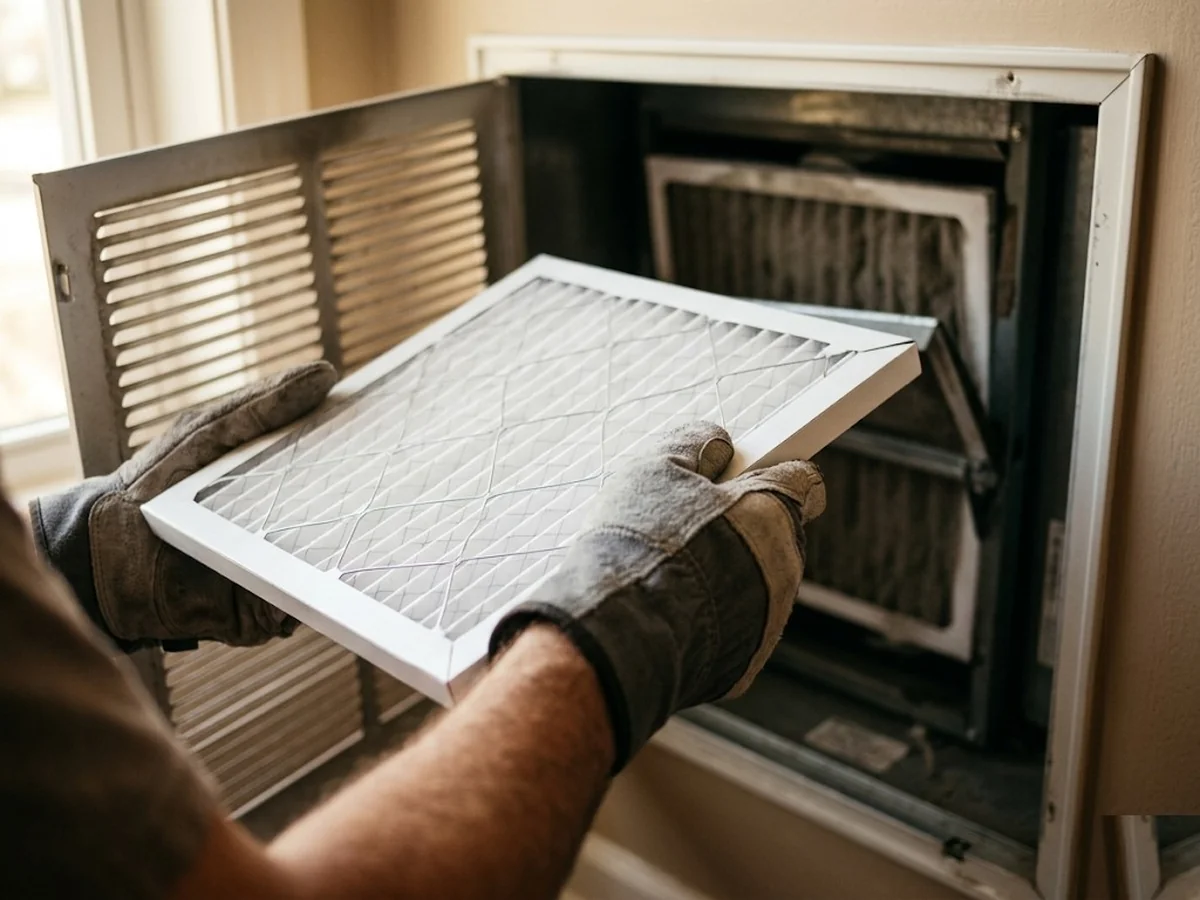
HVAC Maintenance and Tune-Up: What a Real Annual Service Includes
The $49 tune-up ad you saw on the radio is almost always a sales call dressed up as service. A real HVAC tune-up measures things: static pressure, superheat and subcooling, combustion numbers, amp draw. Our network contractors follow the ACCA Standard 4 maintenance checklist and document what they measure, so you can see the health of your system year over year and catch failures before they strand you.
- Annual AC tune-ups in 2026 cost $85 to $225 and pay for themselves in year-one efficiency gains.
- Furnace and AC both need service annually; heat pumps need both heating and cooling checks.
- Real tune-ups measure static pressure, superheat, subcooling, and combustion; most checklist tune-ups do not.
- Maintenance plans run $175-$450/year for dual-visit service; usually include priority dispatch and 10-15% repair discounts.
- Manufacturer warranties explicitly require documented annual maintenance on most brands; skipping it voids coverage.
01HVAC Maintenance in 2026: What the Industry Will Not Tell You
The HVAC service industry has a dirty secret about tune-ups: most of them are marketing exercises designed to get a tech inside your home to sell repairs or system replacements. The radio-ad $49 special is the clearest example. Our network has a different philosophy, based on the ACCA Standard 4 checklist and what manufacturers actually require to preserve warranty coverage. A real tune-up measures things. It measures static pressure, superheat, subcooling, amp draw, combustion, and capacitance. It documents those measurements on a written report. Year over year, those numbers tell you whether your system is healthy, degrading slowly, or degrading fast.
The reason maintenance matters beyond "it's on the manual" is that HVAC systems fail gradually until they fail suddenly. A capacitor that tested at 47.5 uF two years ago, 43.2 uF last year, and 38.8 uF this year will fail next summer. A clean filter in the air handler but a coil caked with dust behind it is burning 12% extra electricity every hour the system runs. A condenser coil half-blocked with cottonwood fluff is adding 15-20 degrees to compressor head pressure and shortening its lifespan by years. None of that shows up until the emergency happens, but all of it shows up on a proper annual tune-up.
02When to Schedule a Tune-Up (And What Season)
03What a Real HVAC Tune-Up Actually Costs in 2026
The $49 special is a Trojan horse. The $85-$225 real tune-up actually includes measurements. Our network pricing breaks down like this:
Why the wide range? Regional labor rates, urban vs. suburban access, and the level of depth the contractor actually delivers. The $85 visits tend to skip static pressure measurement and combustion analysis; the $225 visits include them. Always ask what is specifically measured and whether you get a written report with the numbers. ACCA publishes the industry standard maintenance checklist in ACCA Standard 4 (HVAC Quality Maintenance); reputable contractors follow it and can reference it by name.
04Step-by-Step: What a Proper Tune-Up Includes
Here is the sequence you should see on an AC tune-up. Furnace tune-ups follow a parallel process with combustion analysis replacing the refrigerant-side work.
05Red Flags: How to Spot a Bad Maintenance Contractor
06How Our Matching Works for Maintenance and Tune-Ups
Maintenance matching prioritizes contractors who follow ACCA Standard 4 protocols, provide written service reports, and maintain low customer complaint rates on post-service surveys (under 3% negative in our tracking). Unlike emergency matching, maintenance matching is not time-sensitive; we route you to the contractor with the best quality scores in your area who can accommodate your schedule preference within 1-2 weeks.
For homeowners with multiple systems (like a house with zoned upstairs/downstairs, or a main home plus a detached guesthouse or shop), we coordinate multi-system visits with contractors who can cover everything in a single trip; this usually discounts the per-system cost by 15-25%. Our maintenance plans are offered directly by the contractor, not through us, so there is no middleman markup; we verify plan terms on the front end and audit plan fulfillment through customer surveys 90 and 180 days after signup.
07Questions to Ask Before You Hire a Maintenance Contractor
- Do you follow ACCA Standard 4 or an equivalent written maintenance protocol?
- Will you provide a written service report with specific measurements at each visit?
- What is the minimum visit duration for a tune-up in your company?
- Do you include static pressure measurement in your standard tune-up?
- Do you include combustion analysis on furnace tune-ups?
- How do you document capacitor degradation and other trend-based wear indicators?
- What is included in your maintenance plan, and what is explicitly excluded?
- Do you pull and review manufacturer fault logs on communicating systems?
08Authoritative Resources
- ACCA Standard 4: HVAC Quality Maintenance — the industry standard for what a real tune-up includes
- ENERGY STAR HVAC Maintenance Checklist — homeowner-friendly summary of required service tasks
- NATE Technician Certification — certification validates that your tech has the training to perform proper maintenance
A properly maintained HVAC system runs cleaner, quieter, more efficiently, and longer than a neglected one. That is worth somewhere in the range of $50-$200 per year in energy costs and several years of extended equipment life. The cost of annual service is modest; the cost of skipping it is not. Our network will match you to a contractor who measures what they service and documents what they measure.
What maintenance & tune-up actually costs.
12-month aggregate from our contractor network, national average. Your actual quote depends on equipment, access, and scope.
| Service item | Typical range | What's included |
|---|---|---|
| Single AC tune-up | $85 - $225 | Spring service call |
| Single furnace tune-up | $95 - $245 | Fall service call |
| Heat pump annual (cooling+heating) | $165 - $395 | Two visits or single extended visit |
| Annual maintenance plan (1 system) | $175 - $325 | Covers both visits plus perks |
| Premium maintenance plan | $295 - $495 | Priority dispatch, 15% repair discount, 1-year price lock |
| Commercial RTU maintenance (per unit) | $185 - $395 | Quarterly on most commercial contracts |
| Coil cleaning (outdoor condenser) | $95 - $195 | Add-on; recommended every 2-3 years |
| Coil cleaning (indoor evaporator) | $225 - $475 | Requires access; every 3-5 years |
| Blower wheel cleaning | $175 - $395 | Restores CFM on 10+ year-old systems |
| Duct inspection + static pressure test | $85 - $195 | Diagnostic; often included in plan |
| Combustion analysis (gas furnace) | $65 - $145 | Should be included in furnace tune-up |
| UV light / air purifier install | $395 - $895 | Add-on; recommended based on IAQ assessment |
Maintenance & Tune-Up pricing varies by state.
Top 10 U.S. states by population — pricing variance vs. national average for maintenance & tune-up.
| State | Pricing vs. national | Why |
|---|---|---|
| California | +10% | Pacific HVAC pricing runs 15-20% above national average due to high labor costs, Title 24 (CA) energy compliance overhead, and seismic strap |
| Texas | -5% | South Central pricing runs at or slightly above national average for cooling work due to high tonnage requirements; heating is below average |
| Florida | -7% | Southeast HVAC pricing runs 5-10% below national average for cooling work due to high contractor density and equipment sales volume; heating |
| New York | +5% | Northeast HVAC pricing typically runs 10-15% above national average due to higher labor costs, dense urban access challenges, and oil-to-gas |
| Pennsylvania | +5% | Northeast HVAC pricing typically runs 10-15% above national average due to higher labor costs, dense urban access challenges, and oil-to-gas |
| Illinois | -5% | Midwest pricing tracks close to national average; heating-related work runs slightly higher due to extended winter season and higher heat-pu |
| Ohio | -5% | Midwest pricing tracks close to national average; heating-related work runs slightly higher due to extended winter season and higher heat-pu |
| Georgia | -7% | Southeast HVAC pricing runs 5-10% below national average for cooling work due to high contractor density and equipment sales volume; heating |
| North Carolina | -7% | Southeast HVAC pricing runs 5-10% below national average for cooling work due to high contractor density and equipment sales volume; heating |
| Michigan | -5% | Midwest pricing tracks close to national average; heating-related work runs slightly higher due to extended winter season and higher heat-pu |
Maintenance & Tune-Up issues our network sees most.
System efficiency has declined over several years
Diagnosis: Dirty indoor and outdoor coils, dust-loaded blower wheel, high duct static pressure from clogged filters or damaged ducts.
Typical fix: Coil cleaning (both), blower wheel cleaning, static pressure measurement, filter optimization. — $295 - $795
System runs longer each year to hit the same temperature
Diagnosis: Gradual capacity loss from refrigerant micro-leaks, compressor wear, or airflow degradation.
Typical fix: Weigh-in refrigerant per spec, verify superheat/subcooling, measure airflow, leak search if required. — $225 - $950
Furnace flame looks yellow or flickers
Diagnosis: Dirty burners, dust accumulation in heat exchanger, improper gas pressure, or venting issue.
Typical fix: Pull and brush burners, clean heat exchanger, combustion analysis, verify gas manifold pressure. — $185 - $475
Condensate drain line clogs repeatedly each summer
Diagnosis: No regular maintenance treatment, improper slope, biofilm buildup, or evaporator coil needs cleaning.
Typical fix: Flush drain with nitrogen and water, install condensate tablets, verify trap and slope, clean coil. — $125 - $425
Capacitor weakening (rounded top but not failed)
Diagnosis: Proactive replacement indicated when capacitor reads 10%+ below rated microfarad value.
Typical fix: Replace capacitor before failure during tune-up; avoids mid-summer emergency. — $145 - $295
Contactor showing pitting and wear during annual inspection
Diagnosis: Normal wear from cycling; typically needs replacement every 5-8 years depending on climate.
Typical fix: Proactive replacement during tune-up; costs half what emergency replacement does. — $145 - $295
Maintenance & Tune-Up: step-by-step.
From the moment you call 1-877-877-6723 to the moment work is complete.
Schedule + arrival
Most maintenance booked 1-2 weeks ahead. Tech arrives within 2-hr window. Brings full diagnostic kit + filter inventory.
Outdoor unit service
Power off at disconnect. Coil rinse with garden hose (or chemical clean if heavily fouled). Inspect fan blade, motor bearings, electrical contactor. Tighten loose connections.
Indoor unit service
Replace air filter. Clean evaporator coil (light cleaning or full chemical). Clear condensate drain line. Check blower motor + wheel. Inspect for moisture damage.
Refrigerant + electrical test
Check refrigerant pressures (suction + discharge). Top-off if minor drift (with leak check first). Measure capacitor microfarads. Test contactor operation. Check amp draw.
Combustion analysis (gas equipment only)
Run gas furnace through full cycle. Measure CO + O2 + flue temp. Inspect heat exchanger with borescope. Verify gas pressure to manifold spec.
System verification + report
Run full heat + cool cycle. Verify thermostat calibration. Check static pressure (target <0.5 in WC). Provide written report of condition + any issues found.
Maintenance & Tune-Up: what's safe to DIY vs hire out.
Some tasks are simple homeowner jobs. Others legally require a licensed contractor.
| Task | Verdict | Why |
|---|---|---|
| Replace air filter monthly | DIY OK | Most important DIY task. 5 min, no tools. Use MERV 8-13 filter (higher = better filtration but more restrictive — check system spec). |
| Light coil cleaning with garden hose | DIY OK | Spray inside-out on low pressure with power off at disconnect. Annual prevention. Use coil cleaner ($15) for tougher buildup. |
| Clear condensate drain (annual) | DIY OK | Shop-vac on the drain termination clears most clogs. Pour cup of distilled vinegar down drain quarterly to prevent algae. |
| Replace thermostat batteries | DIY OK | Annual when battery low indicator shows. 2-min job. |
| Refrigerant pressure check | Hire pro | Requires EPA 608 cert + manifold gauges. Improper hookup releases refrigerant ($25K+ EPA fine). |
| Capacitor / contactor electrical test | Hire pro | Capacitors store lethal voltage. Requires discharge tools + training. |
| Combustion analysis on gas furnace | Hire pro | Requires $1,200+ analyzer + training to interpret. CO leakage detection is safety-critical. |
| Heat exchanger inspection | Hire pro | Requires borescope + experience to identify cracks/holes. Missed crack = CO leak risk. |
What your maintenance & tune-up technician will bring.
Standard equipment a licensed maintenance & tune-up contractor carries:
- Manifold gauge set with R-410A and R-22 hoses
- Vacuum pump (if recharge needed)
- Refrigerant cylinder + scale
- Combustion analyzer + CO meter (gas equipment)
- Multimeter + clamp ammeter + capacitor tester
- Coil cleaner + spray bottle + rinse equipment
- Filter inventory (common sizes 16x20, 20x20, 20x25, 16x25)
- Manometer for static pressure
Every major brand for maintenance & tune-up.
| Manufacturer | What our network technicians note |
|---|---|
| Carrier / Bryant | Extended warranty requires annual documented maintenance; Infinity system diagnostics should be run at each visit. Fault history logs invaluable for trend monitoring. |
| Trane / American Standard | 10-year parts warranty requires proof of annual maintenance for full coverage; ComfortLink II fault codes should be pulled and cleared at each service. |
| Lennox | iComfort system diagnostics at each visit; Signature Series requires dealer-trained techs for proper maintenance to maintain warranty. |
| Rheem / Ruud | EcoNet platform allows remote diagnostic pulls; 10-year parts/conditional replacement warranty preserved with documented annual service. |
| Goodman / Amana | Best-in-class warranty (10-year parts, lifetime compressor on Amana) requires registered annual maintenance; relatively forgiving service requirements. |
| York / Coleman / Luxaire | Affinity series needs firmware updates checked during service; Johnson Controls provides online diagnostic access to network techs. |
| Mitsubishi Electric mini-splits | Indoor head cleaning is the big differentiator; blower wheels accumulate slime and dust that kills efficiency; deep cleaning every 2-3 years recommended. |
| Daikin Fit / Daikin One+ | Low-charge A2L refrigerant is sensitive to leaks; annual pressure checks more critical than on older R-410A equipment. |
Maintenance & Tune-Up red flags to watch for.
Common scam patterns in maintenance & tune-up that should make you walk away.
Skips outdoor coil cleaning (says 'looks fine')
Even 'fine looking' coils have airflow restriction from microscopic debris. A real tune-up always includes coil cleaning.
Doesn't measure refrigerant pressures
Refrigerant charge drift is the #1 cause of efficiency loss. Pressure measurement is core to any tune-up.
No written report or service log
Manufacturer warranty often requires documented annual service. No paper trail = warranty void.
Pushes 'flush + recharge' refrigerant routinely
Refrigerant is sealed in the system. If level is low, there's a leak — should be diagnosed and repaired (EPA 608 requires this), not routinely recharged.
Recommends UV light or chemical add-ons during tune-up
These can be legitimate but often pushed as upsells without diagnostic evidence (mold present, IAQ tested). Get justification.
Visit takes <30 min
Real 29-point tune-up takes 60-90 min. <30 min visit = either skipping steps or rushing.
HVAC cost calculator — estimate in 30 seconds.
Tell us a bit about your home and we'll estimate your install range based on 12 months of network quote data. Not a binding quote — matched contractors confirm after an in-home assessment.
Estimate range based on 12-month aggregate network quote data. Matched contractor confirms after in-home Manual-J load calc.
8 questions about maintenance & tune-up.
How often should I have my HVAC system serviced?+
Once per year minimum for each function: AC in spring, furnace in fall, heat pumps for both. Most manufacturer warranties explicitly require documented annual service to maintain coverage. Skipping maintenance can void your parts warranty and accelerate system wear by 30-50%.
How much does an HVAC tune-up cost in 2026?+
A real tune-up with measurements runs $85 to $225 for a single AC or furnace visit. Annual maintenance plans covering both visits plus priority dispatch and repair discounts run $175 to $450. The $49-$79 specials are usually loss leaders for selling repairs; ask what is actually measured before booking.
What should be included in a proper AC tune-up?+
Refrigerant charge verification via superheat and subcooling (not just gauge pressure), static pressure measurement, coil inspection and cleaning, capacitor microfarad test, contactor inspection, amp draw test on motors, condensate system check, thermostat calibration, and a written documented report of measurements.
Is an HVAC maintenance plan worth it?+
Usually yes, for three reasons: the discount compared to paying per visit, priority dispatch during peak seasons, and the 10-15% repair discount most plans include. If your system is over 8 years old, the priority dispatch alone typically justifies the plan during summer or winter emergencies.
What happens if I skip maintenance?+
Three things: system efficiency degrades 5-15% per year it goes unserved (real energy cost), small issues become emergencies (a $25 capacitor caught early vs $450 emergency replacement mid-summer), and most manufacturer warranties become voidable for lack of documented maintenance.
Can I do any HVAC maintenance myself?+
Yes, specifically: replace filters every 30-90 days (the single most impactful thing), keep the outdoor condenser clear of debris and shrubs by 2 feet, gently rinse condenser fins once a year with a garden hose on low pressure, and pour a cup of bleach or white vinegar down the condensate cleanout every 6 months.
How long should an HVAC tune-up take?+
A real AC tune-up takes 60-90 minutes. A furnace tune-up takes 45-75 minutes. A dual visit (AC + furnace) should run 90-120 minutes. Service calls that finish in under 30 minutes skipped critical measurements; these are the $49 specials that mostly exist to sell upsells.
Does a tune-up affect my energy bill?+
Yes, often more than homeowners expect. A neglected system can run 15-25% less efficiently than nameplate rating; a well-maintained system delivers within 5% of rated efficiency throughout its life. On an average $150/month summer cooling bill, that efficiency gap is $25-$35 per month back in your pocket.
You might also need…
Need maintenance & tune-up now?
Free match · 90 seconds · Licensed pros only · Quote before work