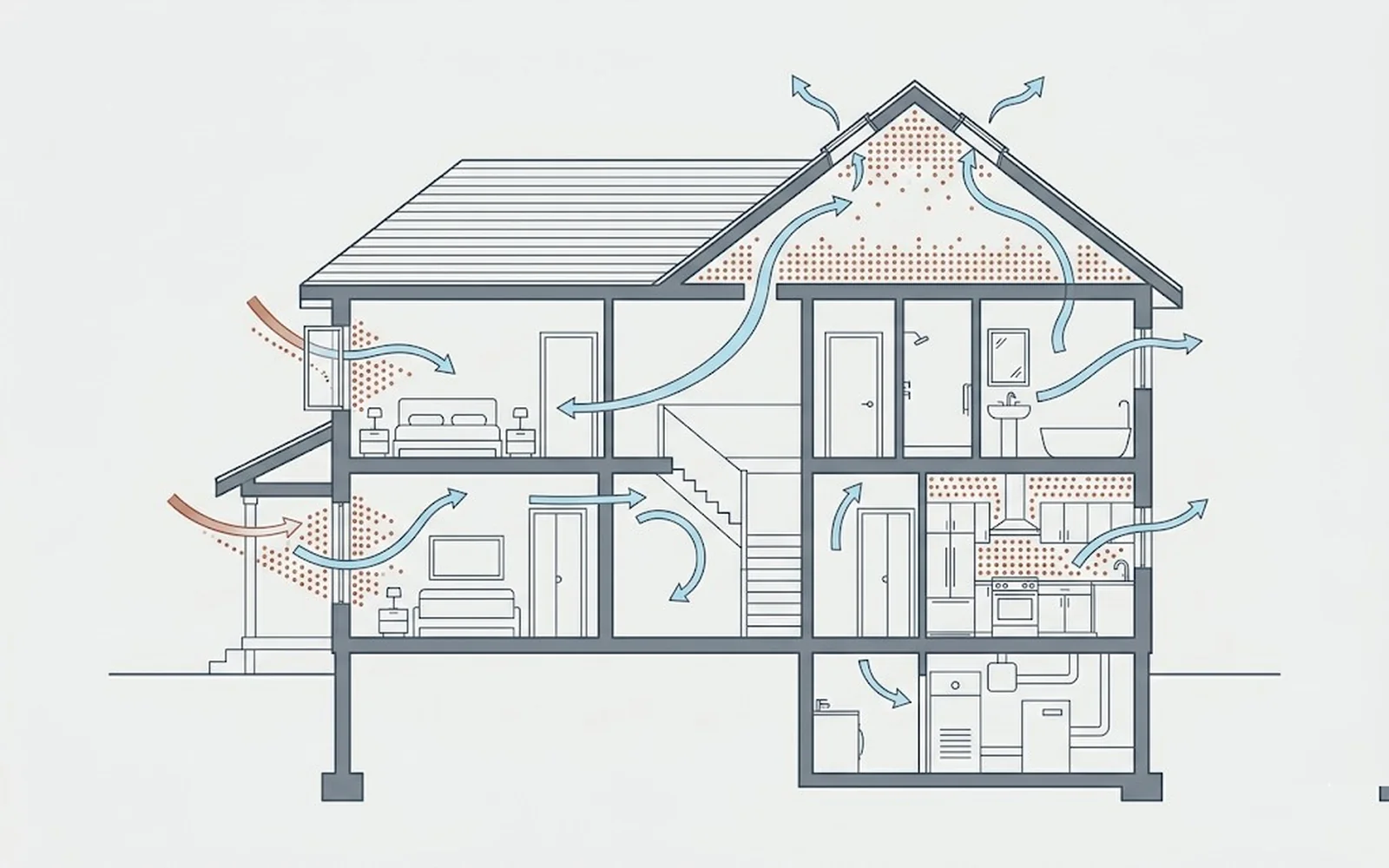
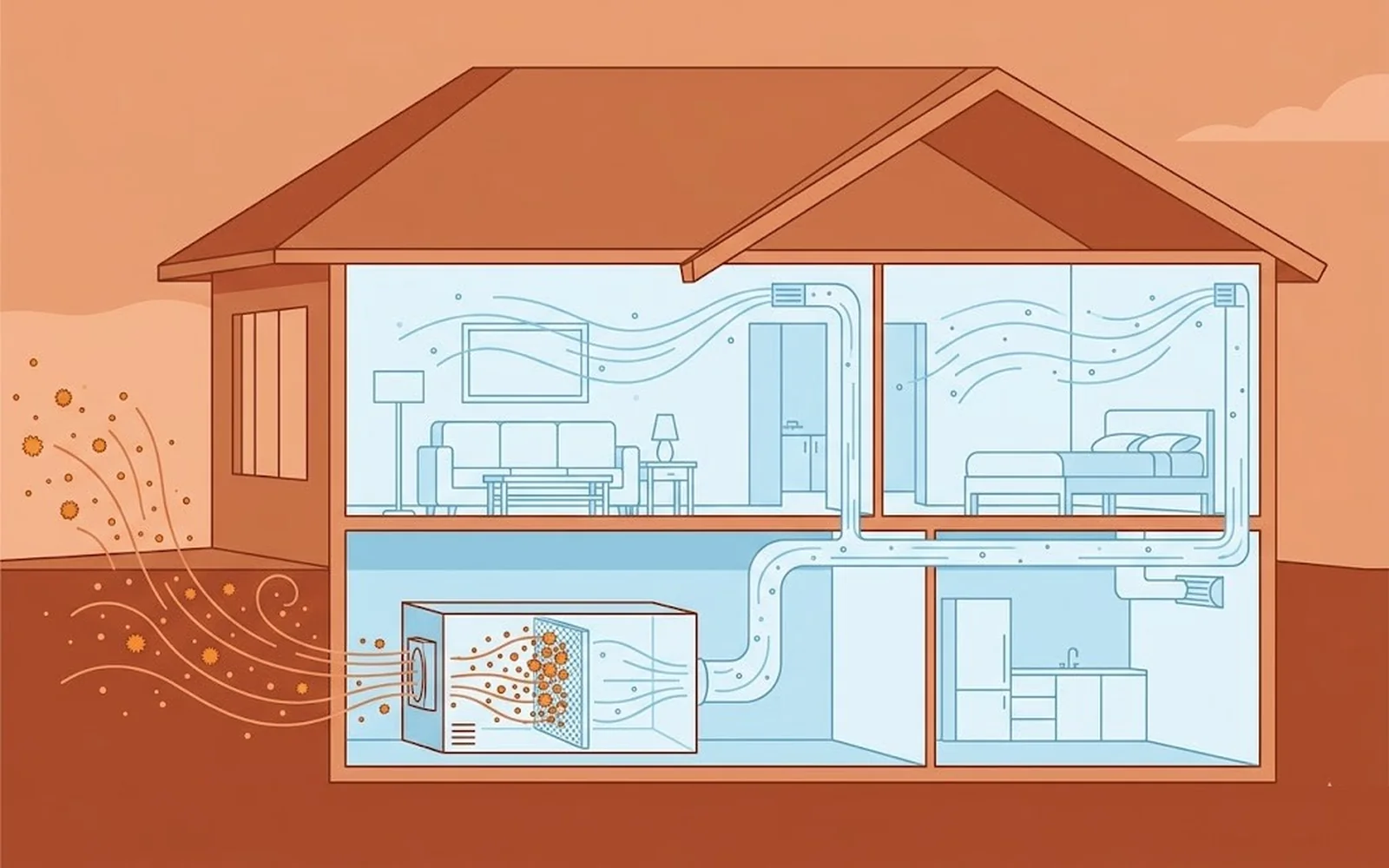
Indoor air quality has become a crowded marketing category, which is a problem because the actual engineering differences between products are meaningful and most homeowners are getting upsold on things that don't do much while skipping things that do. This guide walks through the three major IAQ technology categories — filtration (MERV), UV-C disinfection, and whole-home air purifiers — tells you honestly what each one solves, what it doesn't, and what to install for specific use cases like pet dander, allergies, or wildfire smoke.
01MERV ratings, explained without the marketing
MERV stands for Minimum Efficiency Reporting Value, published in ASHRAE Standard 52.2. It's a 1-16 scale (sometimes extended to 20 for industrial applications) that measures how well a filter captures particles of three size ranges: 0.3–1.0 microns, 1.0–3.0 microns, and 3.0–10.0 microns. Higher MERV = captures more smaller particles.
The common ratings and what they actually do:
The airflow tradeoff nobody tells homeowners about
Here's the thing most filter marketing skips: higher MERV = more airflow resistance = harder work for your blower. A 1-inch MERV 13 filter in a system designed around MERV 8 can measurably reduce airflow, which reduces cooling capacity, which can ice an evaporator coil or overheat a motor. We've seen "premium filter" installs cause more problems than they solved because the system wasn't designed around them.
The fix is one of two paths:
- 4-inch or 5-inch media filters (Aprilaire 5000, Honeywell F200, Trane CleanEffects). Much larger surface area = same MERV rating at half the pressure drop. Requires a dedicated filter cabinet.
- Upgraded blower motor — variable-speed ECM motors handle higher MERV loads without straining.
If you're running 1-inch filters and want to go MERV 13, have your tech measure static pressure before and after the upgrade. Anything above 0.5 inches of water column total external static is a problem.
A MERV 13 filter choking your system is worse than a MERV 8 that isn't. Match the filter to the equipment, not to the marketing.
02UV-C lamps: what they actually do
UV-C lamps (wavelength around 254nm, germicidal range) installed in HVAC systems come in two flavors:
Coil sterilization UV
A lamp mounted to shine continuously on the evaporator coil. The coil is cold, wet, and dark — ideal conditions for biofilm and mold growth, which in turn degrades heat transfer efficiency and releases spores into the air stream. UV-C on the coil kills this biofilm.
This application works. It's well-documented, low-wattage, and typical installed cost is $400–$800. The mechanism is direct — microbes on an irradiated surface accumulate lethal UV dose over hours of exposure. Lamp replacement annually. This is a reasonable upgrade for homes with history of mold issues on the coil or for very humid climates where biofilm is chronic.
Air-sterilization UV (in-duct)
A lamp installed in the duct with airflow passing over it. Marketed as killing airborne bacteria and viruses in real-time.
This application mostly doesn't work as marketed. Air moves through ductwork at 400–800 feet per minute, which means exposure time of any individual microbe passing the lamp is milliseconds. The UV dose required to inactivate a bacterium is dose = intensity × time; with time close to zero, you need enormous intensity, which residential in-duct lamps do not provide. ASHRAE's filtration and disinfection guidance is cautious on in-duct UV-C for air disinfection — the effect is real but small compared to proper filtration.
Our honest take: install UV for coil sterilization if you want, skip the "kills airborne pathogens" marketing. If airborne pathogens are the concern, MERV 13 + controlled ventilation does more than UV ever will.
03Whole-home air purifiers: the real options
Beyond standard HVAC filters, there are several whole-home purifier systems that meaningfully upgrade air quality. The categories:
Bypass HEPA systems
Products like IQAir Perfect 16 and Aprilaire Allergy 5000 install in parallel with the return duct. Air moves through the purifier by its own blower, not the HVAC blower, so HEPA filtration doesn't penalize HVAC airflow. Captures 99%+ of 0.3μ and smaller particles. Install cost typically $2,400–$4,500. Filter replacement $120–$280 annually.
These are the best whole-home solution we've seen. They're not cheap, but they genuinely deliver clinical-grade filtration without compromising HVAC performance. For homes with severe allergies, asthma, or smoke exposure, worth every dollar.
Electronic air cleaners (ESP)
Electrostatic precipitators — Trane CleanEffects, Honeywell F300 — charge particles and collect them on plates. Capture efficiency is high across all particle sizes when clean. Require periodic manual cleaning of the plates (every 2–4 months, DIY).
Concern: older ESP designs can generate ozone as a byproduct. Modern designs (post-2018) are much better, but we'd confirm ozone output testing before installing. The CARB (California Air Resources Board) keeps a list of certified low-ozone air cleaners — this is a useful reference.
PECO / PCO technology
Molekule and a few competitors market Photo Electrochemical Oxidation (PECO) technology — catalytic destruction of pollutants at the molecular level. Lab data is interesting; independent real-world effectiveness has been contested. Portable PECO units run $700–$1,400. We'd call this an experimental category — promising, not yet proven to the level of HEPA.
Portable HEPA units
Coway Airmega, Blueair HealthProtect, IQAir HealthPro. Effective in the room they're placed in, zero effect elsewhere. $300–$1,200 per unit. Genuinely useful for bedrooms (8+ hours of exposure) and for supplementing whole-home filtration during smoke events.
04Use-case-specific recommendations
Heavy pet dander (multiple cats, dogs, shedding breeds)
MERV 11 or 13 with 4-inch media cabinet. UV coil lamp for the humid climate case. Vacuum with HEPA. Replace filter every 60 days instead of 90. Expected IAQ improvement: substantial within 2–3 weeks.
Severe seasonal allergies (ragweed, tree pollen)
MERV 13 minimum, MERV 14 if blower supports. Portable HEPA in bedroom. Run HVAC fan circulation during peak pollen hours rather than letting fan cycle with cooling. Replace filters right before allergy season. Consider whole-home HEPA bypass if symptoms are severe and other measures insufficient.
Asthma / chemical sensitivity
Whole-home HEPA bypass (IQAir Perfect 16 or Aprilaire Allergy 5000). MERV 13 in main HVAC. Focus on radon and VOC testing separately — particulate filtration is only part of the picture. Consider ERV (Energy Recovery Ventilator) to actively exchange stale air.
Wildfire smoke (West Coast, Rocky Mountain, now increasingly Midwest)
Smoke is the hardest case. PM2.5 particles from wildfire smoke are 0.4-0.7 microns on average — below the capture range of MERV 8-11. You need:
A $40 DIY Corsi-Rosenthal box (box fan + 4 MERV 13 filters duct-taped into a cube) is surprisingly effective as a supplemental filtration unit during smoke events. Not a replacement for proper whole-home filtration but a credible gap-filler. UC Davis and EPA research support this.
General household health-consciousness
MERV 13 in a 4-inch cabinet, annual HVAC tune-up including coil inspection, whole-home humidifier/dehumidifier targeting 40–50% relative humidity. Humidity control is an under-discussed IAQ lever — viruses and dust mites both thrive outside the 40–50% band.
05What not to waste money on
06The bottom line
For most homes, the MERV 13 upgrade in a 4-inch media cabinet plus an annual tune-up is the single best IAQ investment — typically $400–$800 installed, meaningful measurable improvement. UV-C on the evaporator coil is a reasonable second layer for mold-prone systems. Whole-home HEPA bypass is the answer for allergy/asthma households willing to invest $2,500–$4,500. Portable HEPA in bedrooms is the cheap supplement that pays off overnight. Wildfire-affected regions need MERV 16 or HEPA plus envelope discipline — everything else is insufficient. Everything beyond that — in-duct air-sterilization UV, ozone-generating ionizers, aroma marketing — is noise. Spend on what measurably works, skip what doesn't, and your indoor air is genuinely cleaner than most commercial buildings in America.