
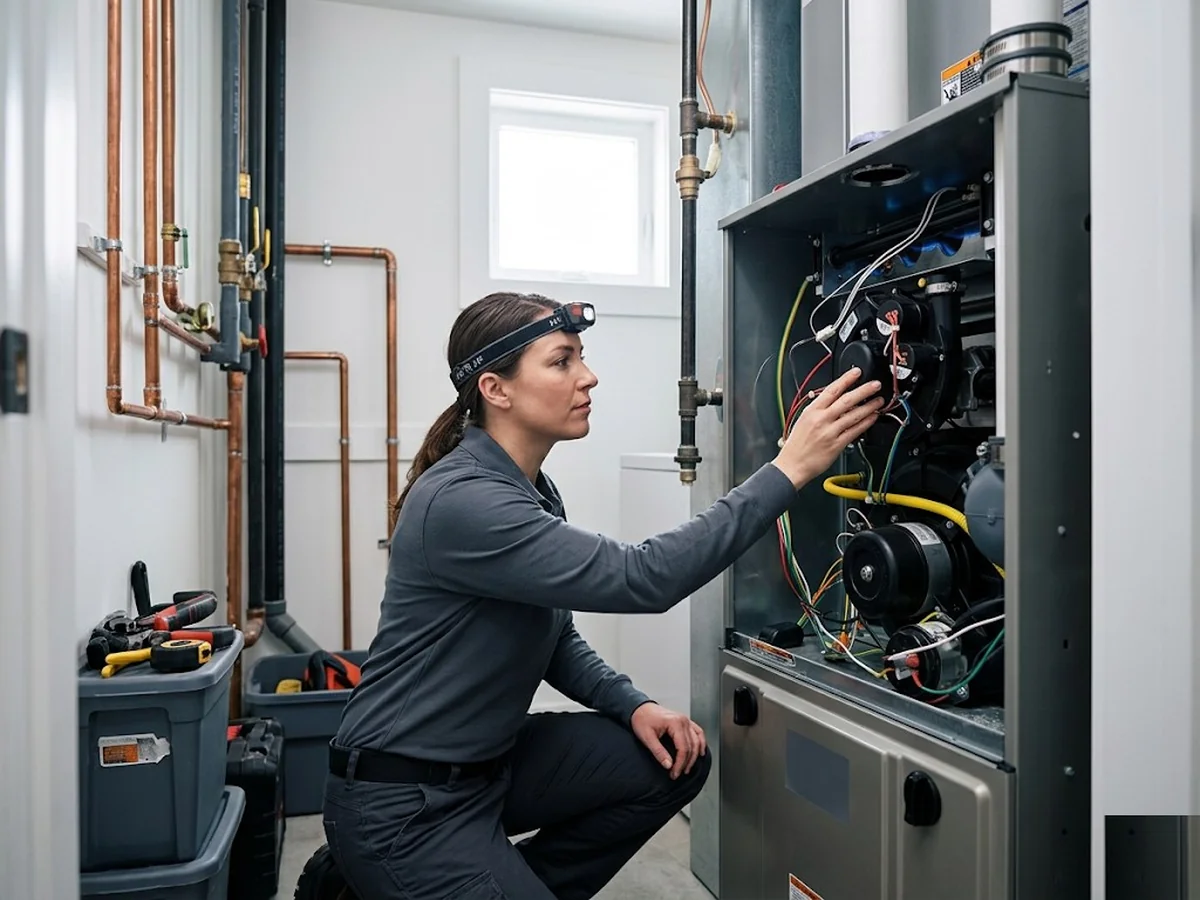
Furnace Repair Near Me: Gas, Electric, and Heat Pump Service, Same Day
A furnace that quits in January is not a project you want to troubleshoot on YouTube. Our network of licensed heating contractors handles gas furnaces, electric furnaces, oil burners, and heat pumps from every major brand, and we dispatch same-day in most metros. You describe the symptom; we put a certified tech in your driveway with the parts truck most likely to solve it on the first visit.
- Most furnace repairs in 2026 cost between $175 and $900 with flame sensors and ignitors on the low end.
- A cracked heat exchanger is a life-safety issue requiring shutdown and replacement or full system swap.
- Heat pump repairs differ from gas furnace repairs; not every HVAC tech is strong on both.
- No heat calls in single-digit weather qualify for emergency dispatch in our network at roughly $100-$200 surcharge.
- Every contractor in our network is trained on CO safety, combustion analysis, and proper draft testing.
01Heating Repair in 2026: Gas, Electric, and Heat Pump
Heating equipment covers four primary categories in most U.S. homes: high-efficiency condensing gas furnaces, standard-efficiency gas furnaces, electric resistance furnaces or air handlers with strip heat, and heat pumps (air-source, geothermal, or dual-fuel). Each has its own failure patterns, its own service procedures, and its own code requirements. Our network matches your symptoms to the right specialist, because a tech who lives on gas furnaces every day is not necessarily the one you want pulling a reversing valve on a variable-speed heat pump.
The heating season is compressed and ruthless in most of the country. A system that limped through last winter often gives up around Thanksgiving. If your furnace is more than 12 years old and has never had a proper combustion analysis, the economics of a cold-weather breakdown argue for a pre-season tune-up rather than a 2 a.m. emergency call. But if you are already in the emergency, our dispatch runs 24/7, and we will tell you honestly when the repair bill has crossed the line into replacement territory.
02When to Call a Pro (And When You Can Troubleshoot)
A few heating issues are genuinely DIY-friendly. Most are not. Here is our triage guide.
03What Heating Repair Actually Costs in 2026
Heating repair pricing is more variable than AC repair because the equipment itself is more diverse. A gas furnace has a combustion side and an electrical/control side; a heat pump has a refrigeration cycle plus electrical controls; an electric furnace has strip heat elements and sequencers. Labor rates also spike during heating season because demand outstrips supply in most metros. The cost table at the top of this page reflects first-quarter 2026 pricing from our active contractor network.
A few factors drive the variance:
The U.S. Department of Energy estimates that proper combustion adjustment alone can improve furnace efficiency by 5-10%, which on an average gas bill pays for a competent repair in a single heating season.
04Step-by-Step: What a Typical Heating Repair Call Looks Like
05Red Flags: How to Spot a Bad Heating Contractor
06How Our Matching Works for Heating Repair
Winter dispatching is different from summer. We prioritize contractors who run dedicated heating teams in the October-through-March window, carry common parts (universal ignitors, flame sensors, pressure switches, inducer kits) on their trucks, and maintain 24/7 emergency availability. When you submit a heating repair request through our site, our router filters for those criteria first, then scores on response time, customer rating, and specialty match (for instance, we will not send a gas-only tech to a Mitsubishi hyper-heat failure).
Heat pumps get extra filtering. A properly diagnosed heat pump problem requires a tech comfortable with both refrigeration and electrical controls; about 60% of our overall network qualifies, and we match specifically from that pool. You will typically hear from your matched contractor within 30 minutes during business hours and within 90 minutes after hours. We cover the full continental U.S. plus Alaska and Hawaii through partner networks.
07Questions to Ask Before You Hire a Heating Contractor
- Are you NATE-certified or hold equivalent certification in gas heating or heat pumps?
- Will you perform a combustion analysis as part of the diagnosis, and will you share the numbers?
- What is your flat-rate price for a flame sensor cleaning, ignitor replacement, and gas valve replacement?
- If you diagnose a cracked heat exchanger, will you show me photos or borescope footage before condemning the system?
- Do you carry universal parts on the truck, or will most repairs require a return trip?
- Do you pull a permit for heat exchanger or burner assembly replacement?
- What is the warranty on parts and labor for this repair?
- If the repair quote exceeds a certain threshold, will you provide a side-by-side replacement comparison?
08Authoritative Resources
- U.S. DOE Energy Saver: Furnaces and Boilers — efficiency standards and maintenance guidance
- North American Technician Excellence (NATE) — the industry's primary tech certification body
- Air Conditioning Contractors of America (ACCA) — Manual J load calcs and best-practice standards
A properly repaired furnace or heat pump is quiet, efficient, and safe. When your system fails, you deserve a diagnosis that is documented in numbers, not hand-waves. Our network is built to deliver that.
What heating & furnace repair actually costs.
12-month aggregate from our contractor network, national average. Your actual quote depends on equipment, access, and scope.
| Service item | Typical range | What's included |
|---|---|---|
| Diagnostic service call (heating season) | $95 - $185 | Some techs waive in emergencies |
| Flame sensor cleaning / replacement | $150 - $300 | Most common no-heat fix |
| Hot surface ignitor replacement | $225 - $450 | Silicon nitride ignitors last 5-8 years |
| Thermocouple (pilot-based systems) | $175 - $325 | Older gravity and pilot furnaces only |
| Gas valve replacement | $525 - $950 | Requires combustion retest after |
| Inducer motor / draft assembly | $450 - $950 | Common failure past year 10 |
| Control board (integrated furnace control) | $425 - $875 | Brand-specific part lead time varies |
| Blower motor (PSC) | $475 - $900 | PSC motors on older single-stage furnaces |
| Blower motor (ECM variable-speed) | $650 - $1,400 | Standard on 2-stage and modulating furnaces |
| Heat exchanger replacement (warranty labor) | $900 - $2,600 | Labor only; exchanger covered by lifetime warranty on most brands |
| Heat pump reversing valve | $750 - $1,800 | Sealed-system work; includes refrigerant recovery |
| Heat pump defrost board | $375 - $700 | Causes ice buildup in winter when failed |
Heating & Furnace Repair pricing varies by state.
Top 10 U.S. states by population — pricing variance vs. national average for heating & furnace repair.
| State | Pricing vs. national | Why |
|---|---|---|
| California | Baseline | Pacific HVAC pricing runs 15-20% above national average due to high labor costs, Title 24 (CA) energy compliance overhead, and seismic strap |
| Texas | Baseline | South Central pricing runs at or slightly above national average for cooling work due to high tonnage requirements; heating is below average |
| Florida | Baseline | Southeast HVAC pricing runs 5-10% below national average for cooling work due to high contractor density and equipment sales volume; heating |
| New York | Baseline | Northeast HVAC pricing typically runs 10-15% above national average due to higher labor costs, dense urban access challenges, and oil-to-gas |
| Pennsylvania | Baseline | Northeast HVAC pricing typically runs 10-15% above national average due to higher labor costs, dense urban access challenges, and oil-to-gas |
| Illinois | Baseline | Midwest pricing tracks close to national average; heating-related work runs slightly higher due to extended winter season and higher heat-pu |
| Ohio | Baseline | Midwest pricing tracks close to national average; heating-related work runs slightly higher due to extended winter season and higher heat-pu |
| Georgia | Baseline | Southeast HVAC pricing runs 5-10% below national average for cooling work due to high contractor density and equipment sales volume; heating |
| North Carolina | Baseline | Southeast HVAC pricing runs 5-10% below national average for cooling work due to high contractor density and equipment sales volume; heating |
| Michigan | Baseline | Midwest pricing tracks close to national average; heating-related work runs slightly higher due to extended winter season and higher heat-pu |
Heating & Furnace Repair issues our network sees most.
Furnace ignites then shuts off after 30-90 seconds
Diagnosis: Dirty flame sensor is the most common cause; less often a cracked heat exchanger, weak inducer, or failed pressure switch.
Typical fix: Clean or replace flame sensor, verify microamp signal (should be 3-6 uA on most modern units), inspect heat exchanger. — $150 - $400
Furnace clicks but will not ignite
Diagnosis: Cracked or glazed hot surface ignitor, failed gas valve, closed pressure switch, or dirty inducer wheel.
Typical fix: Test ignitor resistance (40-90 ohms cold is typical), replace if cracked, verify gas pressure at valve outlet. — $225 - $550
Heat pump blowing cool air in heating mode
Diagnosis: Stuck reversing valve, low refrigerant charge, failed defrost board, or auxiliary heat not engaging below balance point.
Typical fix: Energize reversing valve solenoid manually, check pressures, test defrost board staging, verify aux heat strips. — $350 - $1,800
Furnace runs constantly, never reaches thermostat setpoint
Diagnosis: Undersized system, high static pressure, dirty filter, failing gas pressure, or thermostat anticipator mis-set.
Typical fix: Measure external static pressure, verify gas manifold pressure, inspect ductwork, recalibrate or replace thermostat. — $200 - $950
Loud boom or bang when furnace ignites
Diagnosis: Delayed ignition caused by dirty burners, partially blocked inducer, or incorrect gas pressure. Shutdown hazard.
Typical fix: Pull and brush burners, verify ignitor timing, measure gas pressure at rated input, inspect flame pattern. — $275 - $650
Yellow or orange flame instead of blue
Diagnosis: Incomplete combustion from dirty burners, dust in the heat exchanger, improper gas pressure, or venting issues.
Typical fix: Combustion analysis with digital analyzer, clean burners and heat exchanger, adjust gas pressure to spec, check draft. — $250 - $750
Heating & Furnace Repair: step-by-step.
From the moment you call 1-877-877-6723 to the moment work is complete.
Diagnostic call
Dispatcher takes ZIP, symptom, urgency. Special routing for no-heat in freeze conditions or CO concerns. Matched contractor calls back within 5-15 min.
On-site arrival
Tech arrives in marked truck. Confirms ID, walks through symptom history. For gas furnaces, checks for CO at registers as part of intake.
Diagnostic + safety check
Combustion analysis (CO, O2, draft) + heat exchanger inspection. Visual check for cracks, rust, soot. Identifies root cause + presents flat-rate quote.
Repair work
Most common parts (ignitor, flame sensor, capacitor) on truck — same-visit repair. Heat exchanger crack = recommend furnace replacement. Gas valve order: 1-3 day return visit.
Post-repair safety + verification
Re-runs combustion analyzer to verify CO levels safe (< 100 ppm in flue, < 9 ppm in living space). Confirms thermostat + system run through full heat cycle.
Invoice + warranty
Flat-rate invoice. Parts warranty 1-yr from contractor + 5-10 yr manufacturer (compressor, heat exchanger). Labor warranty 30-90 days.
Heating & Furnace Repair: what's safe to DIY vs hire out.
Some tasks are simple homeowner jobs. Others legally require a licensed contractor.
| Task | Verdict | Why |
|---|---|---|
| Replace air filter | DIY OK | Monthly during heating season. Critical for furnace airflow + heat exchanger longevity. |
| Replace thermostat batteries | DIY OK | Most common 'no heat' false alarm. 2-min job. |
| Reset tripped breaker (one time) | DIY OK | Safe to try once. Repeated tripping = call a pro immediately. |
| Clean flame sensor | Hire pro | Requires removing burner assembly access; voltage testing nearby. Cleaning wrong removes oxide layer that helps flame detection. |
| Replace ignitor | Hire pro | Hot-surface ignitors are fragile (snap on contact with skin oils) and require correct gap to gas burner. Wrong install = repeat failure. |
| Inspect heat exchanger for cracks | Hire pro | Requires combustion analyzer to detect microcracks (CO leakage). Crack = potential CO poisoning. Pro inspection only. |
| Service or repair gas valve | Hire pro | Gas line work legally requires licensed contractor in nearly all states. DIY repair voids manufacturer warranty + insurance coverage. |
| Combustion analysis | Hire pro | Requires $1,200+ analyzer + training to interpret. Annual combustion check is industry standard for furnaces. |
What your heating & furnace repair technician will bring.
Standard equipment a licensed heating & furnace repair contractor carries:
- Combustion analyzer (Bacharach, Testo — $1,200+ instrument)
- Multimeter + clamp ammeter
- Gas pressure manometer (inches of water column)
- Manometer for static pressure (duct system)
- Flame sensor cleaning kit (scotch-brite, fine sandpaper)
- Hot-surface ignitor inventory (common Honeywell/White-Rodgers part numbers)
- Inducer motor + condensate trap kit
- CO alarm + ambient testing meter
Every major brand for heating & furnace repair.
| Manufacturer | What our network technicians note |
|---|---|
| Carrier / Bryant | Infinity 98 modulating furnaces are industry leaders on efficiency; secondary heat exchangers have had corrosion claims on 2016-2019 production runs. |
| Trane / American Standard | XC95m and S9V2 two-stage units run quiet and last; hot surface ignitors on pre-2020 models fail at 4-6 years rather than the typical 7-10. |
| Lennox | SLP99V modulating furnace is top-tier but control board (#103447-01) has documented failure issues around year 5-7; parts are dealer-only. |
| Rheem / Ruud | Prestige R98V modulating is solid value; the inducer motor on R802 mid-efficiency units is a common failure at year 8-10. |
| Goodman / Amana | GMVC96 modulating furnace offers exceptional warranty (lifetime heat exchanger, 10-year parts) at budget pricing; gas valves have had occasional supplier issues in 2022-2023. |
| York / Coleman / Luxaire | YP9C modulating is reliable; Affinity series control boards sometimes trip on false flame sense due to ground path issues on older homes. |
| Mitsubishi Electric (heat pumps) | Hyper-Heat H2i pumps heat reliably to -13F; the refrigerant charge is critical and any leak repair requires full weigh-in, not top-off. |
| Daikin / Daikin Fit | Daikin One+ heat pumps and gas furnaces are slim-profile and highly efficient; the communicating thermostat has had Wi-Fi stability issues with some routers. |
Heating & Furnace Repair red flags to watch for.
Common scam patterns in heating & furnace repair that should make you walk away.
Quotes furnace replacement without showing the heat exchanger crack
Heat exchanger replacement = furnace replacement decision. Pro should show you the crack on borescope camera or with smoke test before recommending $5K+ replacement.
Skips combustion analysis
Combustion analysis is the only way to verify CO levels and burner adjustment. A pro who skips this either doesn't have an analyzer (red flag) or cuts corners (worse).
Doesn't check or test for CO leaks
Cracked heat exchangers leak CO into living space. Annual CO check is industry standard. Skipping = liability.
Tries to repair a clearly cracked heat exchanger
Heat exchangers cannot be safely repaired — they must be replaced. 'Patching' a crack is dangerous and against manufacturer specifications.
No flat-rate quote before work begins
Open-ended T&M pricing is the #1 source of HVAC pricing disputes.
Refuses to discuss venting or combustion air requirements
Improper venting causes CO poisoning. A pro should discuss intake/exhaust path during any furnace work.
HVAC cost calculator — estimate in 30 seconds.
Tell us a bit about your home and we'll estimate your install range based on 12 months of network quote data. Not a binding quote — matched contractors confirm after an in-home assessment.
Estimate range based on 12-month aggregate network quote data. Matched contractor confirms after in-home Manual-J load calc.
8 questions about heating & furnace repair.
How much does furnace repair cost in 2026?+
Most heating repairs run $175 to $900 depending on the part and furnace type. Flame sensors and ignitors are on the low end; gas valves, control boards, and blower motors climb into the $500 to $1,400 range. Heat exchanger replacements cost $900 to $2,600 in labor even with warranty parts.
Why is my furnace blowing cold air?+
The most common cause is the blower running during start-up or cool-down; that is normal. If cold air continues after start-up, the burners are not staying lit (flame sensor), the ignitor failed, the gas valve is stuck, or a safety switch has tripped. A tech diagnoses in under an hour.
Is a cracked heat exchanger really dangerous?+
Yes. A cracked heat exchanger can leak carbon monoxide into your supply air. Every licensed contractor in our network red-tags cracked exchangers and shuts down the gas supply until replacement. Most modern furnaces carry lifetime heat exchanger warranties, so parts cost is usually zero; labor runs $900 to $2,600.
What is the difference between a heat pump and a furnace?+
A furnace burns gas or uses electric resistance to create heat. A heat pump moves heat from outside air into your home using a refrigeration cycle; it runs on electricity and also provides cooling. Heat pumps can lose efficiency below about 30F unless they are cold-climate rated.
How do I know if my ignitor is bad?+
A hot surface ignitor that glows briefly, then the furnace tries again and locks out after three attempts, is almost always a failed ignitor. Cold resistance should read 40 to 90 ohms; open-circuit means replacement. Our techs carry universal ignitors for same-visit repair.
What happens if I smell gas near my furnace?+
Leave the house immediately, call 911 or your gas utility from outside, and do not operate any electrical switches. A minor thermocouple pilot outage is one thing; a persistent gas odor is a life-safety emergency. We dispatch after the utility confirms the home is safe to re-enter.
Can you repair oil furnaces?+
Yes, though oil technicians are a specialty subset. About 40% of our network covers oil heat across the Northeast and Mid-Atlantic. Common repairs include nozzle replacement, cad cell eye cleaning, oil filter changes, and combustion chamber service. We match oil-specific techs when your system calls for it.
How long should a furnace last?+
Gas furnaces average 15 to 20 years; heat pumps average 12 to 15. Annual maintenance, clean filters, and proper sizing extend that. If your system is past year 15 and needs a $1,500+ repair, our techs will give you the honest side-by-side cost of replacement before you spend on a dying unit.
You might also need…
Need heating & furnace repair now?
Free match · 90 seconds · Licensed pros only · Quote before work